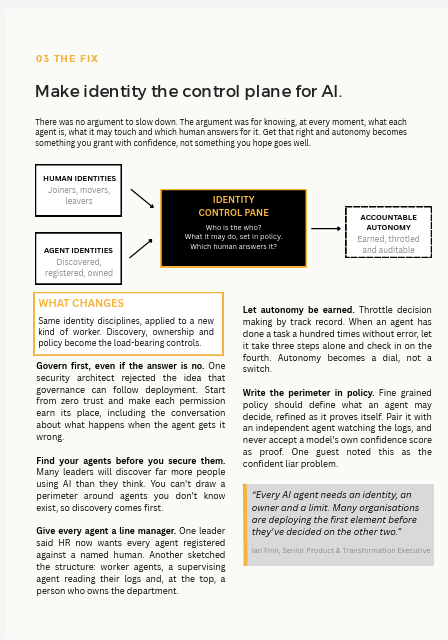
Every AI agent needs an identity, an owner and a limit
Every AI agent needs an identity, an owner and a limit. Cited in The Security Shift from Change Makers Club, here is why most organisations are getting the order wrong.
I’m pleased to share that I’ve been cited as a contributing voice in a new industry report from Change Makers Club: The Security Shift: Your agents have the keys. But who secures them?
It draws on a roundtable of senior technology, security and product leaders held in London in September 2026, and the full report is available to download below.
The conversation in the room
Most organisations have moved past asking whether to use AI. The harder question now is what happens when AI stops simply answering and starts acting: booking, buying, approving and changing records on someone’s behalf. As the report puts it, AI agents are being handed access faster than anyone can say who they are, what they may do, or who answers for them.
“Identity and Access is now the control plane for every decision AI makes.”
The Security Shift, Change Makers Club
My contribution
My contribution, on page 4, is a simple test any organisation can apply today:
“Every AI agent needs an identity, an owner and a limit. Many organisations are deploying the first element before they’ve decided on the other two.”
Identity, owner, limit: why the order matters
Identity. An agent isn’t the user, and shouldn’t borrow the user’s credentials. It needs its own identity, so you can see what it did, on whose behalf and when. This is the part most organisations get to first, because the technology makes it easy.
Owner. Someone has to be accountable for each agent, in the same way a product leader owns a roadmap. Without a named owner, risk falls between teams, and nobody notices when an agent’s behaviour drifts.
Limit. Every agent needs a defined boundary: what it may access, what it may decide on its own, and when a human has to step in. Limits should be refined as an agent proves itself, not set once and forgotten.
Deploying identity without the other two is like issuing someone a building pass without saying who they report to or which floors they’re allowed on. The pass works perfectly, and that is the problem.
In my own experience of running identity at scale, every entity acting in a system needs its own identity, whether that is a human user, an authenticated service, another non-human entity or, now, an AI agent. Only then can the system strike the right balance between access, productivity, security and risk.
Building trust into products at scale is one of the threads running through my book, Product Truths, and it was good to see the same theme come through so strongly from such a varied room.
Read the full report
My thanks to George Whittington and the Change Makers Club team for bringing the conversation together and turning it into something practical.
[Download The Security Shift report (PDF)]
If you’re working through how identity and trust need to evolve as AI agents take on more, I’d welcome the conversation.