Every AI agent needs an identity, an owner and a limit
Every AI agent needs an identity, an owner and a limit. Cited in The Security Shift from Change Makers Club, here is why most organisations are getting the order wrong.
I’m pleased to share that I’ve been cited as a contributing voice in a new industry report from Change Makers Club: The Security Shift: Your agents have the keys. But who secures them?
It draws on a roundtable of senior technology, security and product leaders held in London in September 2026, and the full report is available to download below.
The conversation in the room
Most organisations have moved past asking whether to use AI. The harder question now is what happens when AI stops simply answering and starts acting: booking, buying, approving and changing records on someone’s behalf. As the report puts it, AI agents are being handed access faster than anyone can say who they are, what they may do, or who answers for them.
“Identity and Access is now the control plane for every decision AI makes.”
The Security Shift, Change Makers Club
My contribution
My contribution, on page 4, is a simple test any organisation can apply today:
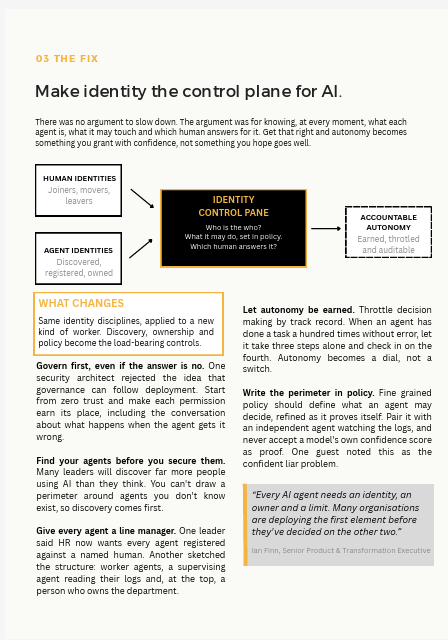
“Every AI agent needs an identity, an owner and a limit. Many organisations are deploying the first element before they’ve decided on the other two.”
Identity, owner, limit: why the order matters
Identity. An agent isn’t the user, and shouldn’t borrow the user’s credentials. It needs its own identity, so you can see what it did, on whose behalf and when. This is the part most organisations get to first, because the technology makes it easy.
Owner. Someone has to be accountable for each agent, in the same way a product leader owns a roadmap. Without a named owner, risk falls between teams, and nobody notices when an agent’s behaviour drifts.
Limit. Every agent needs a defined boundary: what it may access, what it may decide on its own, and when a human has to step in. Limits should be refined as an agent proves itself, not set once and forgotten.
Deploying identity without the other two is like issuing someone a building pass without saying who they report to or which floors they’re allowed on. The pass works perfectly, and that is the problem.
In my own experience of running identity at scale, every entity acting in a system needs its own identity, whether that is a human user, an authenticated service, another non-human entity or, now, an AI agent. Only then can the system strike the right balance between access, productivity, security and risk.
Building trust into products at scale is one of the threads running through my book, Product Truths, and it was good to see the same theme come through so strongly from such a varied room.
Read the full report
My thanks to George Whittington and the Change Makers Club team for bringing the conversation together and turning it into something practical.
[Download The Security Shift report (PDF)]
If you’re working through how identity and trust need to evolve as AI agents take on more, I’d welcome the conversation.

The Identity Paradox: Reflections on AI from the boardroom and from the back of a taxi
A ChangeMakers roundtable on non-human identities and AI governance, and a taxi ride home that put the same question in miniature: can the systems we trust actually be trusted with what matters most?
Privileged and invigorated to have been part of lively debate this week, on the very topical thread of non-human identities, now proliferating across organisations as a consequence of the AI adoption surge. By 2027 it is predicted that 74% of organisations will be using AI Agents (Deloitte study, 2026).
The event was a #ChangeMakers round table on ‘The Security Shift’ that is consequently underway, as non-human identities proliferate at pace. The discussions progressed through the AI adoption curve, governance considerations, practical challenges and looking to ensure cross-org alignment, whilst the pace of change is more rapid than the process, procedures and guardrails that follow in its wake. I offered a point about the conundrum proposed by the ‘Identity Paradox’, whereby organisations experience intense downward exec pressure to implement AI at pace; but the balancing capabilities in controls and checks and balances are often stretched to keep up.
The quality of discussion in the room was excellent and perfectly on point for this critical topic - bringing together tech leaders operating where bleeding edge Identity, AI and Security intersect.
With AI now being such a pervasive element of modern life, it was perhaps not a surprise that even the taxi ride home was ‘on topic’. Travelling back in a cab from Guildford station, I found myself in conversation with the driver, who was telling me his own AI story and the impact it had on the lives of both him and his family, particularly for his daughter, who was experiencing learning difficulties. Utilising AI to research and uncover local authority and other support resources, he relayed how AI was an accelerating force in helping him navigate the hugely complex routes to securing help for his daughter, via untangling a web of complex processes.
That's the identity paradox in miniature. In the room, we debated how to govern non-human identities before they outpace our controls. In the cab home, AI was already, quietly, helping a father navigate a system built for humans, on behalf of a daughter who needed it most. Two very different rooms. The same question: can the systems we trust actually be trusted with what matters most to us?

AI and Identity discussions in the room


Can We Build It? Wrong Question.
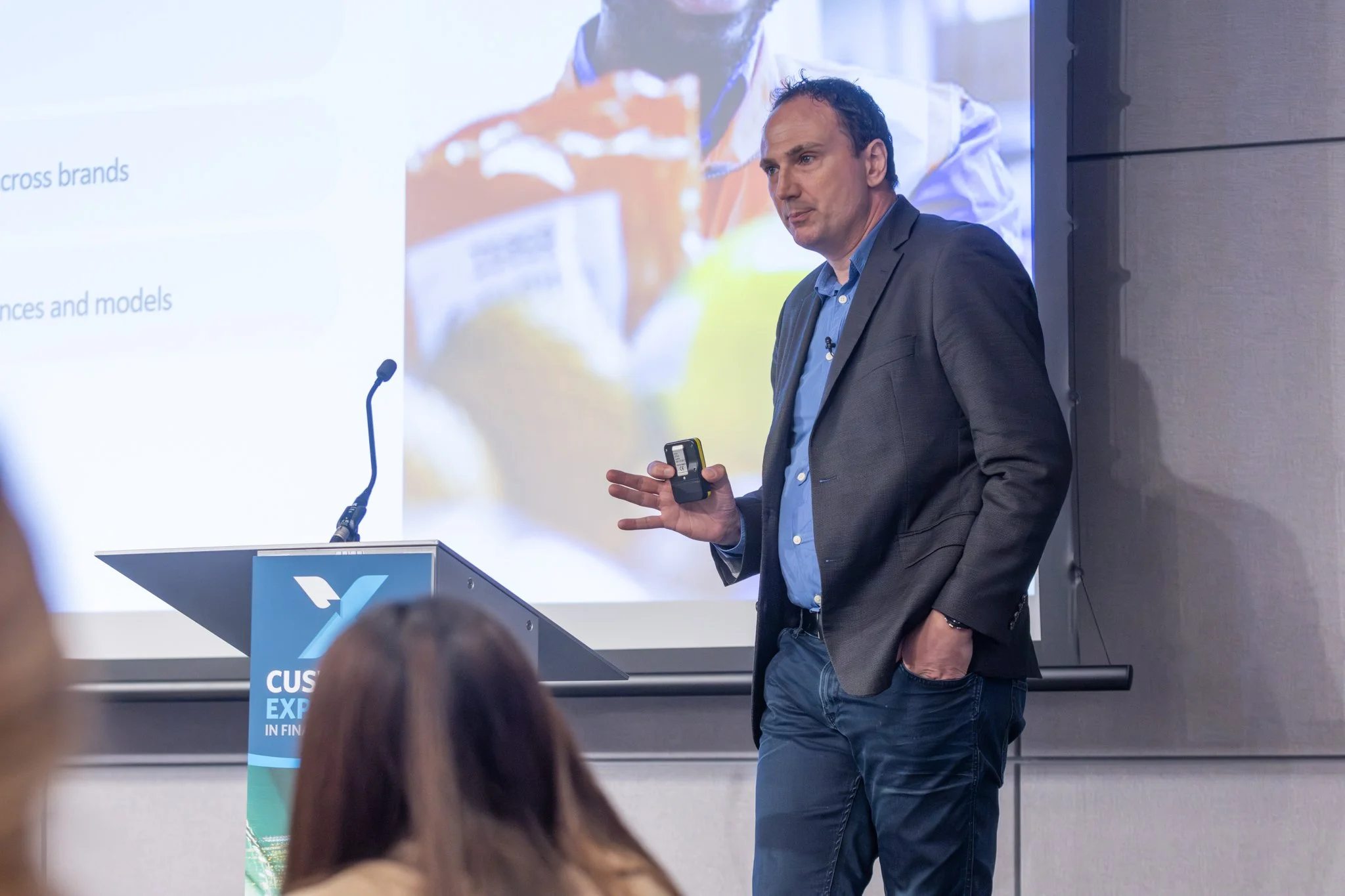
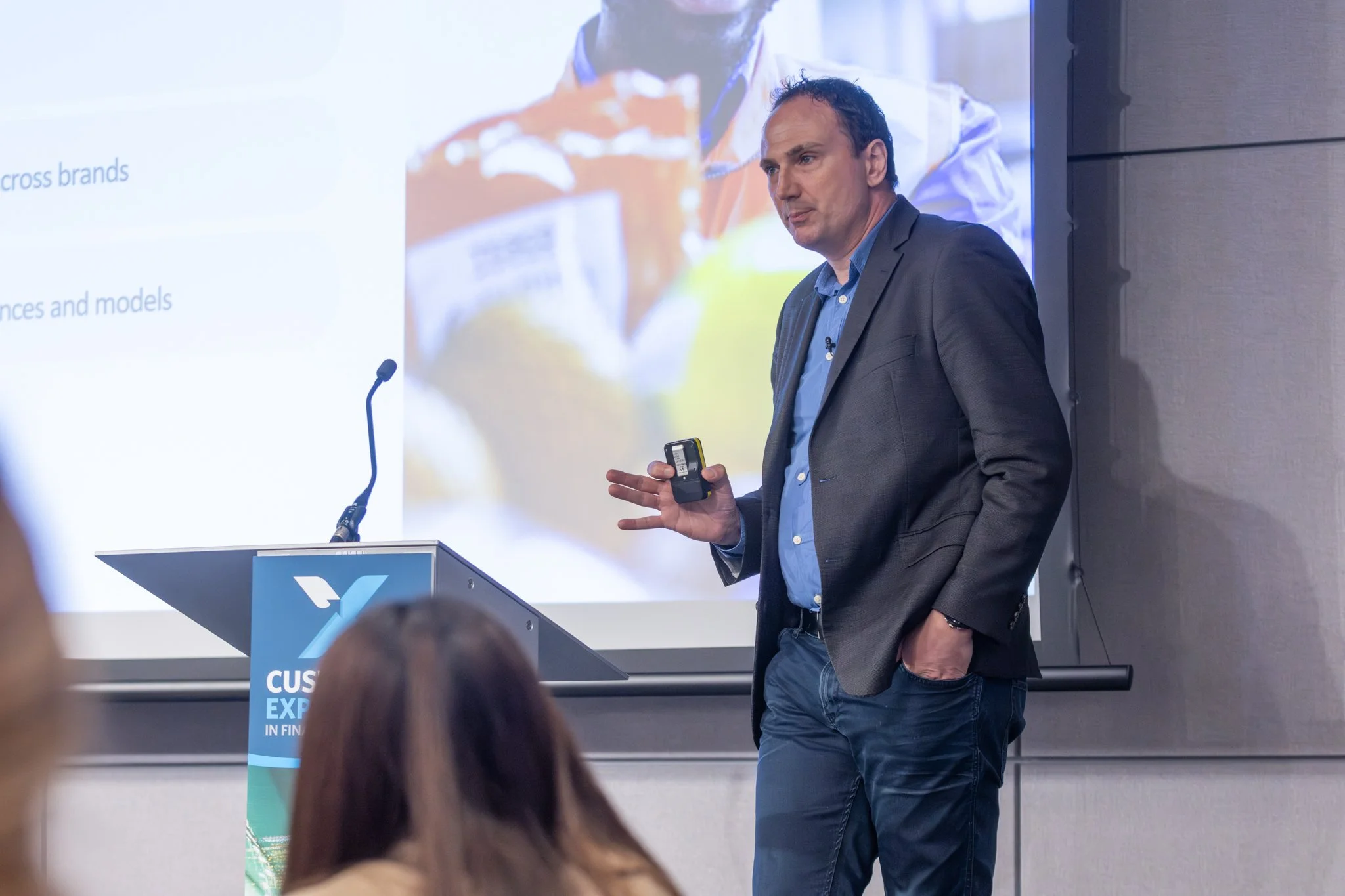
Ian Finn talking about AI-powered personalisation, at Customer Experience in Financial Services 2026.
Two days at CXFS26. One thing stuck with everyone who spoke there: the conversation has genuinely shifted — from "can we build this" to "can our customers actually trust it?"
Arena International have just released their official highlight reel from Customer Experience in Financial Services 2026 — a good snapshot of where senior leaders in the sector are actually spending their attention right now: AI and the invisible infrastructure customers never see but always feel.
My contributions are in there — on personalisation in the age of AI, and my reflections on the show as a whole.
What's your take on where AI-powered personalisation is headed in the next 5 years?
⬇️ Watch the full video here →https://www.youtube.com/watch?v=zQok5QQ3bps&t=73s ⬇️