

Who owns AI? Everyone's chasing the ball, no one's in position
What a London round table of senior leaders taught me about AI ownership, baselines and why half the budget should go on people.
23 Nov
Written by Ian Finn
AI often feels like a football match where everyone is chasing the ball, but no one is playing in position or to an overall formation.
That was the thrust of my contribution to a round-table dinner of senior leaders in London in early October, hosted by The Network with Verizon Business. The debate is now captured in an industry report, Everybody bought the car. Nobody built the Chargers., which tackles a perplexing question: who leads AI?
The title comes from an analogy drawn early in the evening. Electric cars were adopted enthusiastically and sold far faster than the charging infrastructure could keep pace. AI feels much the same: the ambition is real, but the structure to support it often isn't.
Around the table were leaders from banking, retail, pharma, law, media and the public sector. The brief moved beyond adoption to a harder question: how do organisations set themselves up for success as adoption continues apace? The discussion centred on ownership, budgets, data and people. With pressure to embed AI often strong and coming from above, the usual governance, process and ownership definitions have struggled to keep up.
My contribution, as cited in the report:
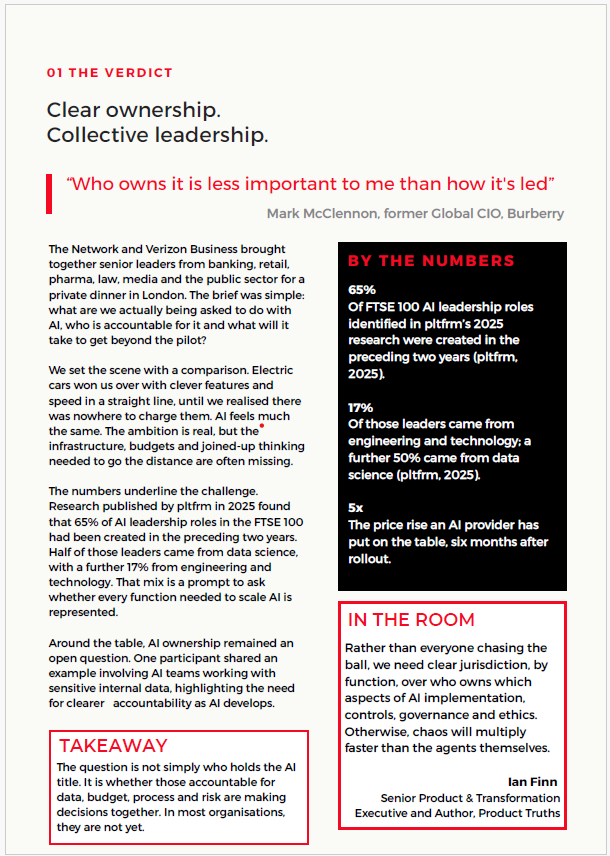
Rather than everyone chasing the ball, we need clear jurisdiction, by function, over who owns which aspects of AI implementation, controls, governance and ethics. Otherwise, chaos will multiply faster than the agents themselves.
Ownership by function
The question is less who holds the AI title than whether those accountable for data, budget, process and risk are making decisions together. Clear boundaries stop capable people duplicating effort, or leaving gaps no one notices.
Baselines before business cases
One example stayed with me. A leader inherited forecast AI savings with no quantified baseline to measure them against, which makes the target effectively meaningless. It is what happens when the rush is to adopt first and ask questions later: processes that are standard elsewhere get short-circuited.
Strategy, not an adjunct
AI vision needs to be tied much more closely into business strategy, rather than sitting beside it. That also lets standard processes for investment cases, governance and controls apply in a joined-up way.
Spend half on the people
One organisation's call was to spend half of the implementation budget on people, so that change is designed, embedded and properly trained. As the report notes, one law firm went further: nobody gets the AI platform until the training is done.
Three questions for a Monday morning
Who owns which aspects of AI, by function?
Is every AI savings case built on a quantified baseline?
Is enough of the budget going on people, not just platforms?
In my book, ‘Product Truths’, one of my five key principles is ‘teams build products, not individuals’. Applied to AI adoption and embedding phenomen, I would contend that the various interested functions in organisations need to pull together as an ‘outcome focussed team’ to set up for true AI success. Across business, compliance and goverenance as well as product and technology; and not be all chasing the ball on an individual basis.
My thanks to The Network and Verizon Business for a thoroughly topical and superbly hosted evening of peer debate from the sharp end of AI strategy.
Read the full report, Everybody bought the car. Nobody built the Chargers., here:
https://lnkd.in/p/ep4qJiTN


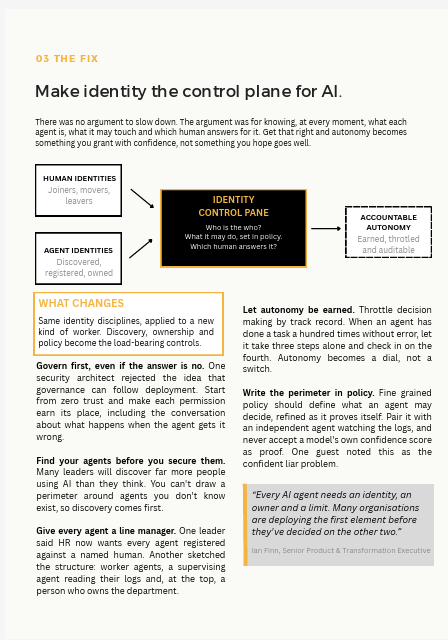
Every AI agent needs an identity, an owner and a limit
Every AI agent needs an identity, an owner and a limit. Cited in The Security Shift from Change Makers Club, here is why most organisations are getting the order wrong.
I’m pleased to share that I’ve been cited as a contributing voice in a new industry report from Change Makers Club: The Security Shift: Your agents have the keys. But who secures them?
It draws on a roundtable of senior technology, security and product leaders held in London in September 2026, and the full report is available to download below.
The conversation in the room
Most organisations have moved past asking whether to use AI. The harder question now is what happens when AI stops simply answering and starts acting: booking, buying, approving and changing records on someone’s behalf. As the report puts it, AI agents are being handed access faster than anyone can say who they are, what they may do, or who answers for them.
“Identity and Access is now the control plane for every decision AI makes.”
The Security Shift, Change Makers Club
My contribution
My contribution, on page 4, is a simple test any organisation can apply today:
“Every AI agent needs an identity, an owner and a limit. Many organisations are deploying the first element before they’ve decided on the other two.”
Identity, owner, limit: why the order matters
Identity. An agent isn’t the user, and shouldn’t borrow the user’s credentials. It needs its own identity, so you can see what it did, on whose behalf and when. This is the part most organisations get to first, because the technology makes it easy.
Owner. Someone has to be accountable for each agent, in the same way a product leader owns a roadmap. Without a named owner, risk falls between teams, and nobody notices when an agent’s behaviour drifts.
Limit. Every agent needs a defined boundary: what it may access, what it may decide on its own, and when a human has to step in. Limits should be refined as an agent proves itself, not set once and forgotten.
Deploying identity without the other two is like issuing someone a building pass without saying who they report to or which floors they’re allowed on. The pass works perfectly, and that is the problem.
In my own experience of running identity at scale, every entity acting in a system needs its own identity, whether that is a human user, an authenticated service, another non-human entity or, now, an AI agent. Only then can the system strike the right balance between access, productivity, security and risk.
Building trust into products at scale is one of the threads running through my book, Product Truths, and it was good to see the same theme come through so strongly from such a varied room.
Read the full report
My thanks to George Whittington and the Change Makers Club team for bringing the conversation together and turning it into something practical.
[Download The Security Shift report (PDF)]
If you’re working through how identity and trust need to evolve as AI agents take on more, I’d welcome the conversation.


No one photographs the planning. Only the peak.
Ian Finn on top of Irton Pike, Cumbria, July 2026
Setting out on a day's hike last week in Cumbria with my great friend @DavidPull – the preparation was extensive and wide-ranging. Before we even set foot on the trail, there was more planning than most people would ever realise. New walking boots, spare laces, a pre-chilled bottle of water for the forecast heat, a fully charged phone and battery pack.
Summiting the peak is just the final, visible part. The part that makes the memorable photo, the soundbite or the outcome summary.
What no one sees is the journey before the ascent: the compounding experience of previous hikes, checking local weather conditions in advance, the specific kit choices for the day – even who you choose to climb with.
That same invisible preparation is what separates robust, resilient systems from fragile ones. The great systems – the ones that scale seamlessly and bounce back quickly when tested – are the product of stress-testing every angle in advance: informed trade-offs, fall-backs ready to deploy, contingent processes that kick in at exactly the right moment, and the right people on the team. That's what lets a team react gracefully under pressure – an incident, an unexpected outage, a system taking an unexpected turn – rather than scrambling in the moment.
The best, and safest, hill climbs don't just 'happen'. The planning, preparation and forethought account for most of the outcome long before the summit comes into view. Systems at scale are no different – the day-to-day micro-actions of optimising frameworks, honing documentation, and keeping run books slick and ready for the worst. That's no accident either; it's by design.
The next time you see a clean outcome — a summit photo, a smooth incident response, a system that just works — remember you're only seeing the final 10%.
 + Plus Perspectives
Whether it's climbing a mountain or operating a complex system at scale, the steps to success are similar:

Photo: me on top of Irton Pike, near Stanton Bridge, Cumbria, July 2026

Photo: Irton Pike, Cumbria - panoramic view, July 2026