Who owns AI? Everyone's chasing the ball, no one's in position
What a London round table of senior leaders taught me about AI ownership, baselines and why half the budget should go on people.
23 Nov
Written by Ian Finn
AI often feels like a football match where everyone is chasing the ball, but no one is playing in position or to an overall formation.
That was the thrust of my contribution to a round-table dinner of senior leaders in London in early October, hosted by The Network with Verizon Business. The debate is now captured in an industry report, Everybody bought the car. Nobody built the Chargers., which tackles a perplexing question: who leads AI?
The title comes from an analogy drawn early in the evening. Electric cars were adopted enthusiastically and sold far faster than the charging infrastructure could keep pace. AI feels much the same: the ambition is real, but the structure to support it often isn't.
Around the table were leaders from banking, retail, pharma, law, media and the public sector. The brief moved beyond adoption to a harder question: how do organisations set themselves up for success as adoption continues apace? The discussion centred on ownership, budgets, data and people. With pressure to embed AI often strong and coming from above, the usual governance, process and ownership definitions have struggled to keep up.
My contribution, as cited in the report:
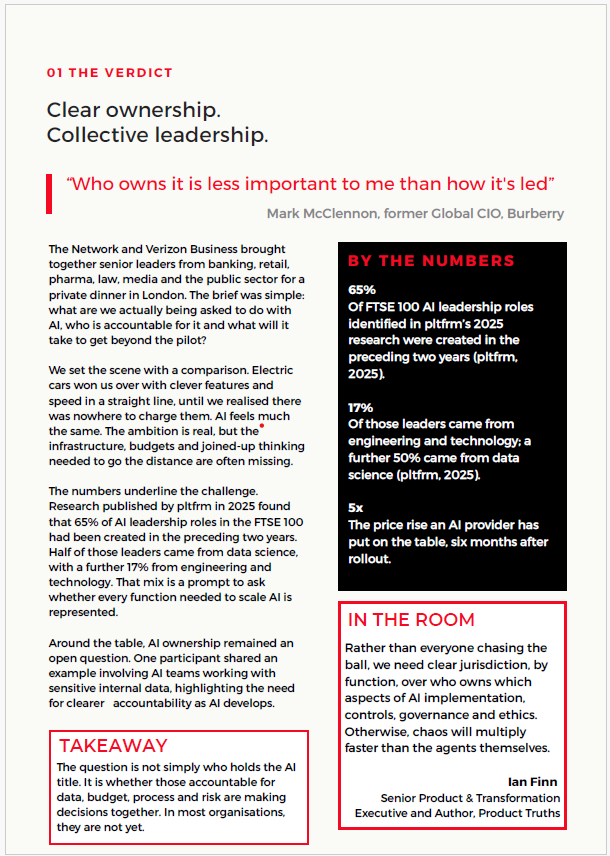
Rather than everyone chasing the ball, we need clear jurisdiction, by function, over who owns which aspects of AI implementation, controls, governance and ethics. Otherwise, chaos will multiply faster than the agents themselves.
Ownership by function
The question is less who holds the AI title than whether those accountable for data, budget, process and risk are making decisions together. Clear boundaries stop capable people duplicating effort, or leaving gaps no one notices.
Baselines before business cases
One example stayed with me. A leader inherited forecast AI savings with no quantified baseline to measure them against, which makes the target effectively meaningless. It is what happens when the rush is to adopt first and ask questions later: processes that are standard elsewhere get short-circuited.
Strategy, not an adjunct
AI vision needs to be tied much more closely into business strategy, rather than sitting beside it. That also lets standard processes for investment cases, governance and controls apply in a joined-up way.
Spend half on the people
One organisation's call was to spend half of the implementation budget on people, so that change is designed, embedded and properly trained. As the report notes, one law firm went further: nobody gets the AI platform until the training is done.
Three questions for a Monday morning
Who owns which aspects of AI, by function?
Is every AI savings case built on a quantified baseline?
Is enough of the budget going on people, not just platforms?
In my book, ‘Product Truths’, one of my five key principles is ‘teams build products, not individuals’. Applied to AI adoption and embedding phenomen, I would contend that the various interested functions in organisations need to pull together as an ‘outcome focussed team’ to set up for true AI success. Across business, compliance and goverenance as well as product and technology; and not be all chasing the ball on an individual basis.
My thanks to The Network and Verizon Business for a thoroughly topical and superbly hosted evening of peer debate from the sharp end of AI strategy.
Read the full report, Everybody bought the car. Nobody built the Chargers., here:
https://lnkd.in/p/ep4qJiTN