Why Product Leaders Should Stay Current in Marketing, Not Just Technology
A CIM CPD renewal is easy to file under housekeeping. Ian Finn argues it's actually a case for something rarely said aloud: staying current in marketing discipline isn't a detour from product leadership, it's foundational to doing it well.
I renewed my Chartered Marketer status with CIM this week. My CPD for the year has been assessed and approved, and CFCIM stands confirmed for another twelve months.
It would be easy to file that under housekeeping. I think it's worth more than that.
There's a common assumption that product leadership and marketing discipline are adjacent but separate: one builds the right thing, the other tells people it exists. In my experience that's a false separation. The best product decisions I've made have drawn on marketing fundamentals as much as technical ones.
Personalisation isn't just a feature to ship. It's a discipline built on genuinely understanding audience segments, how their needs and wants differ, not just having the data infrastructure to act on them. Segmentation thinking, knowing precisely who you're building for and why each cohort differs from the next, shapes better roadmap prioritisation than usage analytics alone ever will. And audience understanding, the ability to read what a customer actually needs rather than what they say they want, is a marketing instinct I've relied on as often as any product framework.
Staying current in these disciplines, through CPD, through active practice, and simply by not letting the fundamentals atrophy, has made me a more effective product leader, not a distracted one. The two disciplines were never as separate as they're often treated.
Grateful to CIM for the annual discipline of reflection this renewal requires. It's a genuinely useful exercise: an honest account of a year's learning, rather than letting it pass unexamined. It's also a habit worth recommending to any product leader who assumes marketing rigour is someone else's job. The ability to segment audiences, target them with personalised propositions, and build a coherent go-to-market strategy is fundamental to doing product well.
The CIM’s CFCIM professional badge
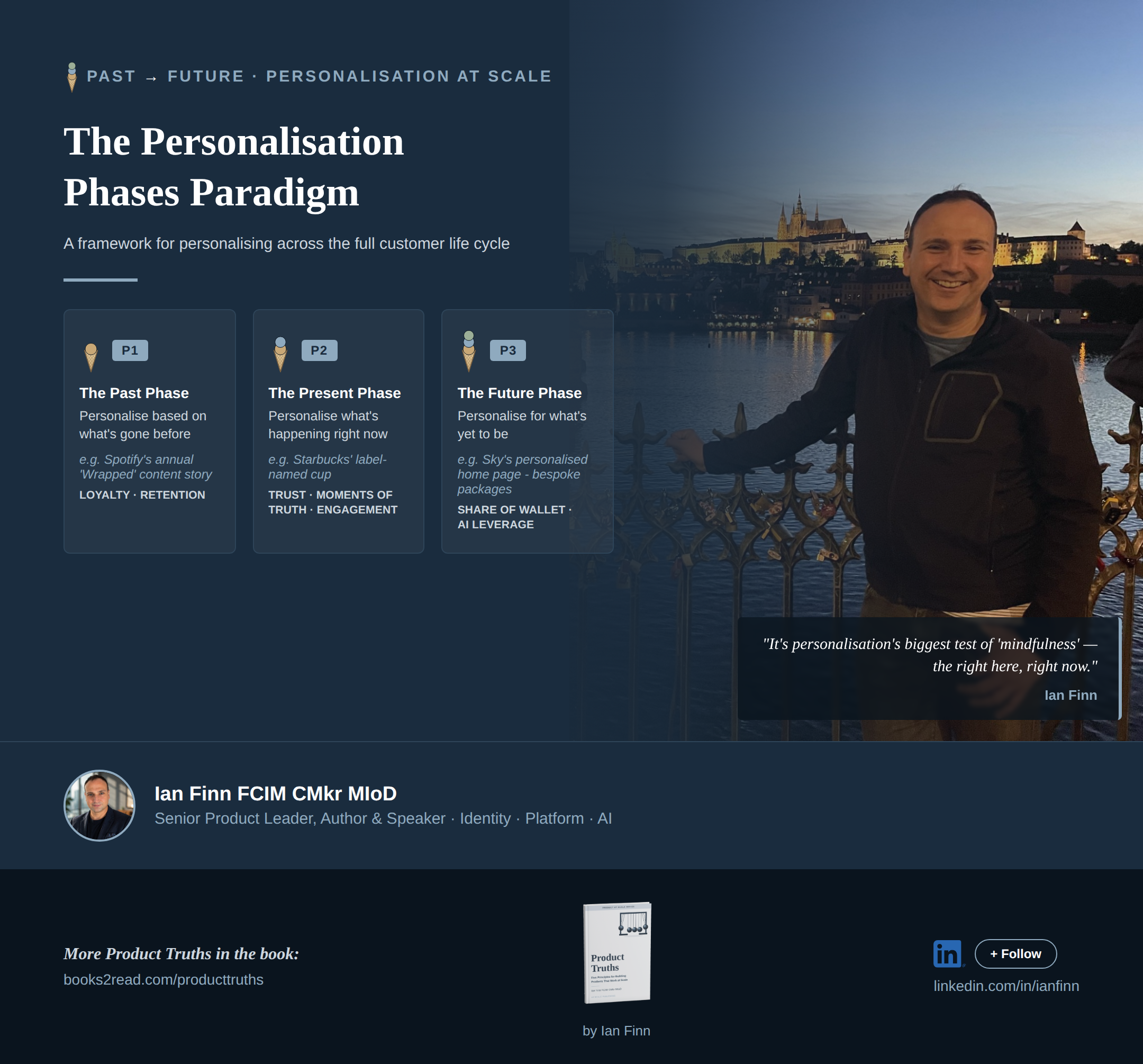
The 'Personalisation Phases Paradigm': A Framework for Personalising at Scale
Most brands treat personalisation as one thing. It's actually three, past, present, and future, each with its own data, its own tactics, and its own payoff. Here's the framework.
-Ian Finn on Personalisation-
Personalisation is the modern day elixir. The ability for services, preferences, recommendations, gamification, and loyalty to all be tailored and individualised for the specific customer being targeted. It's the ultimate in one-to-one marketing meeting relevant experience: targeting bigger basket sizes, and supporting "retention via relevance" across the customer life cycle, all at the same time. Personalisation strategies are proven to move the needle; industry research consistently links strong personalisation to measurable gains in conversion and retention. And consumers desire such personalised experiences too: a global survey in 2024 of 23,000 consumers by BCG found that 80% of them were comfortable with personalised experiences, with most of them expecting brands to offer them.
All worthy outcomes for brands at scale to target. But how can brands truly succeed in a marketing-meets-tech discipline where, by its very nature, success hinges on cutting through the wider noise?
A framework I have developed and found to work well across sectors is to base both the inputs and outputs of a personalisation strategy on key "phases" of the customer life cycle itself, the very chain of events, and phases of data availability, that provide the fuel for a personalised strategy in the first place.
The key starting premise is segmenting the customer life cycle into three "phase views," which provide the inputs for the personalisation tactics to play out. It's an approach I call the Personalisation Phases Paradigm. Let's break it down.
To succeed in personalisation, we know it's all about being relevant, in the moment, on as individualised a basis as possible, often in as close to real time as possible. This is where the Personalisation Phases Paradigm comes into its own, because it's naturally defined by time.
The Personalisation Phases Paradigm in practice
1. Personalisation Phase P1 (the past): Personalise based on what's gone before
This phase leverages the most reliable and most available data and modelling of all, because it's about things that have already happened. That gives it the added benefit of being the phase with the highest potential for accuracy.
It's about taking what we know of an individual and applying a next best action, based on our read and interpretation of the past, to drive an outcome of value.
Examples here would include personalising based on past consumption, like Spotify's annual "Wrapped" in-app carousel, telling a one-of-a-kind story about a user's year of content consumption, or a brand's mobile app summarising which retailers or brands loyalty points were earned with.
Great for: loyalty and retention plays, brand engagement, deepening consumer interest.
2. Personalisation Phase P2 (the present): Personalise based on what's happening right now, in the moments of truth
This phase is about being as relevant and tailored to the current moment of interaction as possible. It's personalisation's biggest test of mindfulness, because it's about the right here, right now. Data systems, timeliness, and how systems interconnect and hold current-state awareness all have to be genuinely on point.
Examples of this one would include the Starbucks coffee that arrives at the end of the counter with your name already on the cup, without you needing to say "my name's Max," because it's been pre-printed from a scan of your loyalty app while paying. Another would be an ecommerce basket's "additions" recommendations, which dynamically adapt cross-sell nudges by modelling likely customer thinking as items are added or removed in real time.
Great for: brand engagement, moments of truth, building trust and deepening customer relationships, cross-sell and upsell.
3. Personalisation Phase P3 (the future): Personalise based on what's yet to be
This phase is about personalising for potential outcomes that the personalisation itself helps bring about. These tactics include overlaying algorithms or "propensity models" onto historic, verified data, to influence and change behaviours. It's about blending measured data points from the past with likely future scenarios, and leveraging both together for competitive advantage.
Because this phase relies most intensely on data leverage, signalling, propensity rules, and orchestrating touches by cohort, it's also the phase that can most usefully harness AI as a genuine force multiplier.
Examples here would include a personalised home page on a Sky TV web account, suggesting a more suitable subscription package for the household, or a tailored "next best action" nudge in a digital banking app, suggesting a switch away from paper statements when blended with data on which customer cohorts feel strongly about environmental issues.
Great for: building and growing transaction volumes and value, increasing share of wallet, and influencing customer behaviour in mutually beneficial ways.
So there you have it. A framework for personalisation across the phases of the customer life cycle, leveraging data, models, and AI progressively as more data points become available over time. I've found it highly useful in building personalisation strategies across a range of industry sectors.
Personalisation succeeds best when context, data, tools, AI, identified need, and trust all intersect. The Personalisation Phases Paradigm provides a framework to succeed at that, at scale.
> Searching for more ways to compound the benefits in your product? More in the book, ‘Product Truths: Five Principles for Building Products That Work at Scale’. Available at all major digital bookstores (Amazon Kindle, Kobo, Apple Books):
www.Books2read.com/producttruths
Insight referenced in article - BCG 2024 consumer study into personalisation preferences:
https://www.bcg.com/publications/2024/what-consumers-want-from-personalization
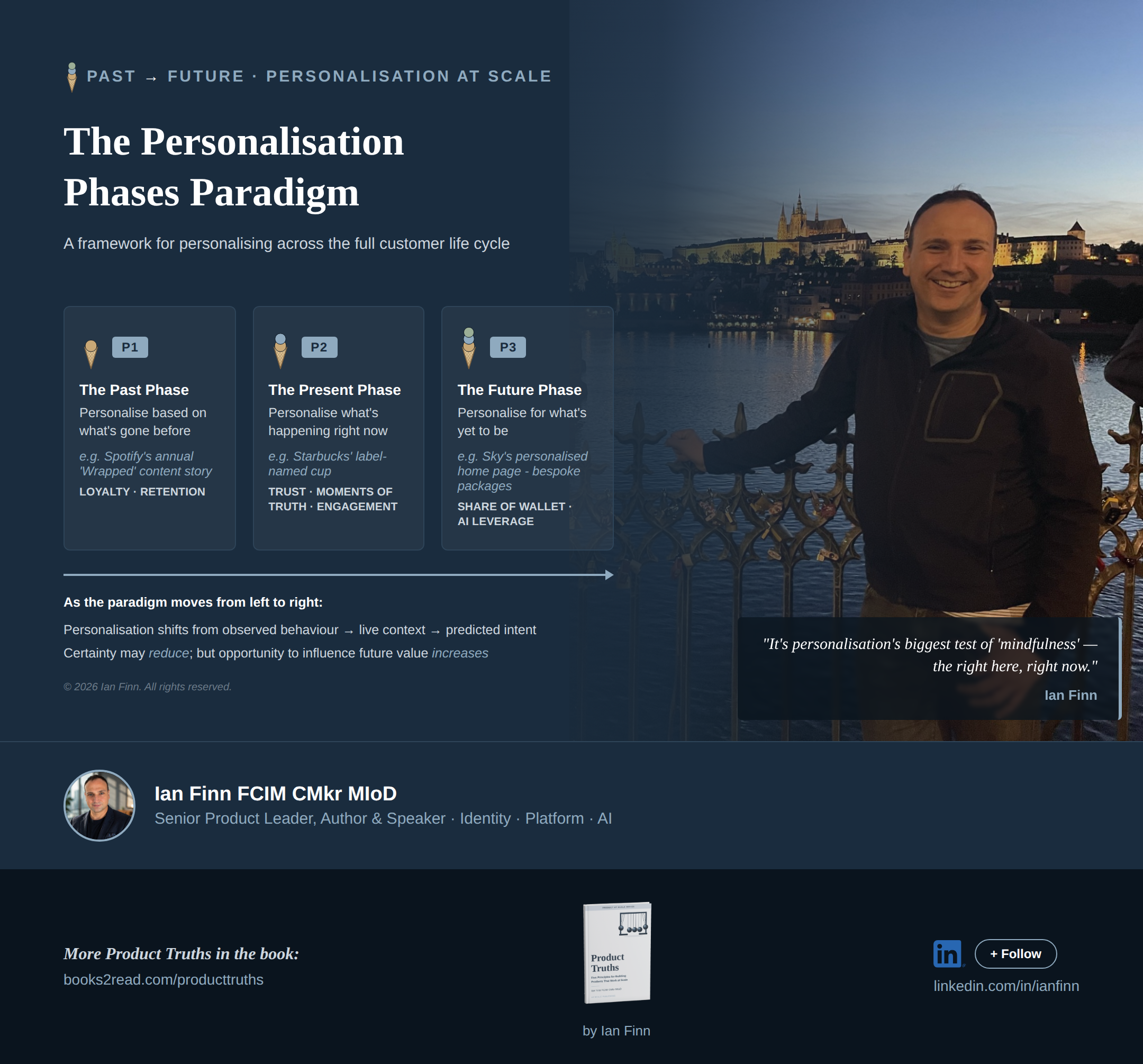
The ‘Personalisation Phases Paradigm’ 2026 Ian Finn. All rights reserved.
Can We Build It? Wrong Question.
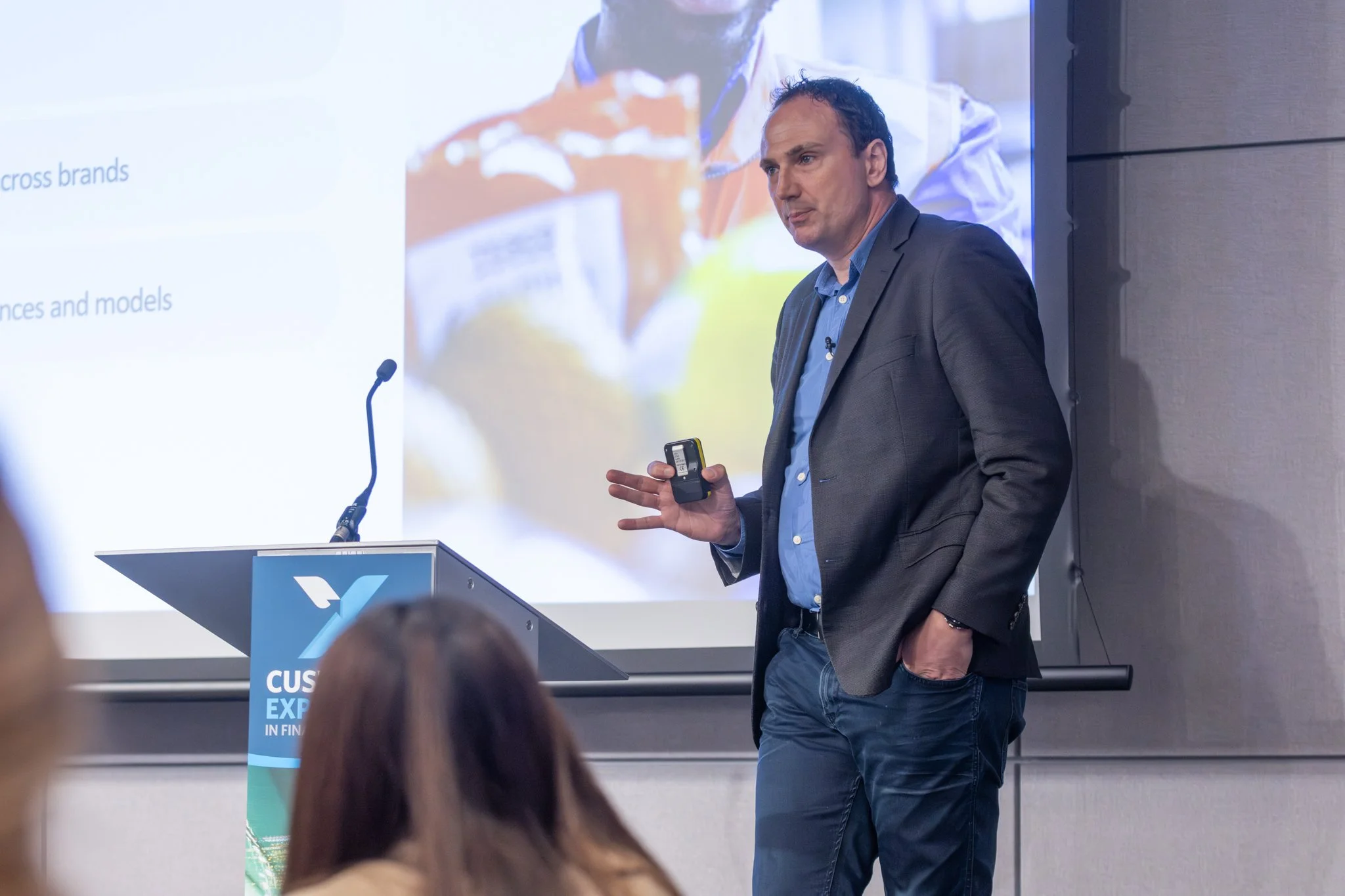
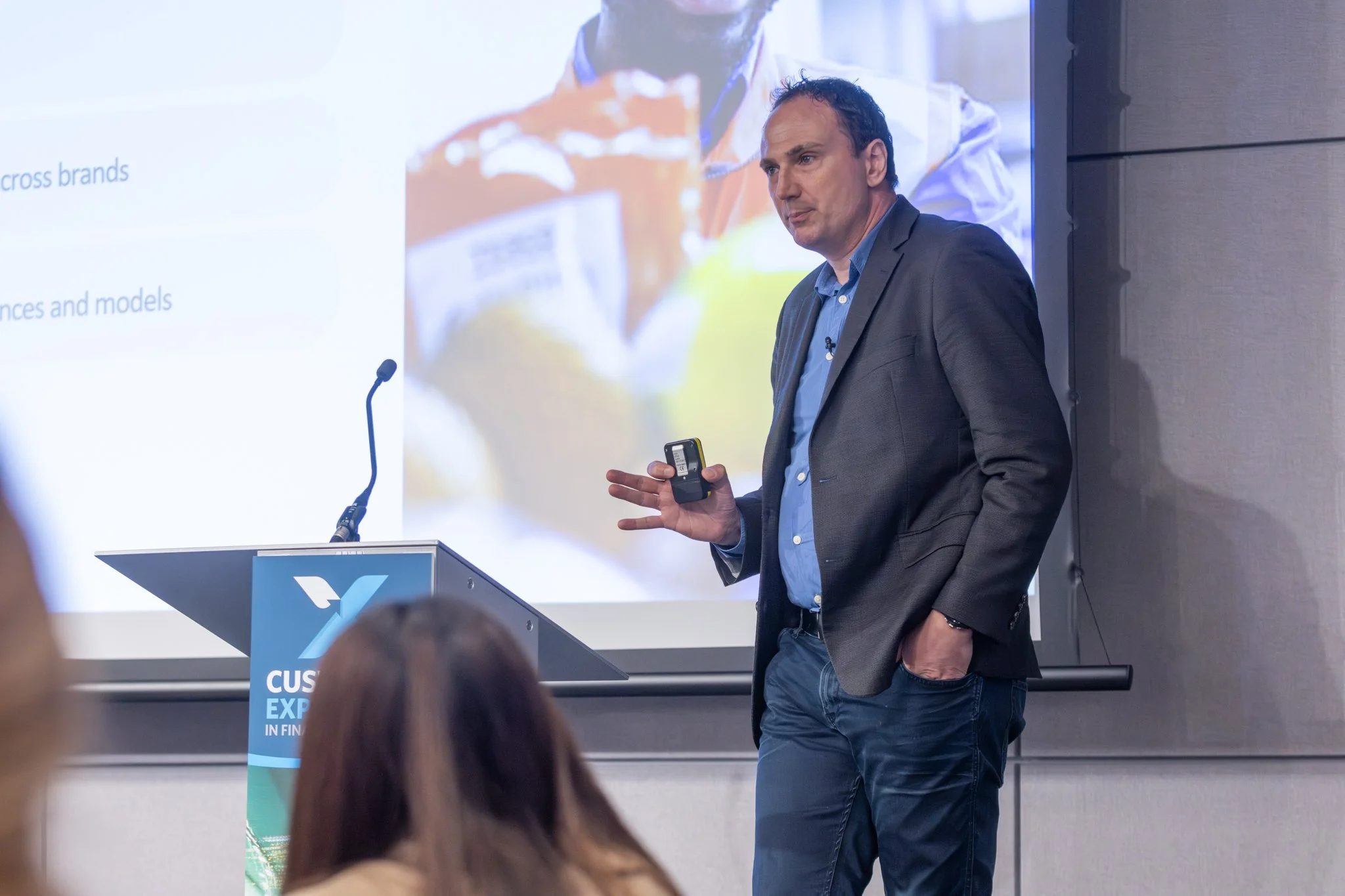
Ian Finn talking about AI-powered personalisation, at Customer Experience in Financial Services 2026.
Two days at CXFS26. One thing stuck with everyone who spoke there: the conversation has genuinely shifted — from "can we build this" to "can our customers actually trust it?"
Arena International have just released their official highlight reel from Customer Experience in Financial Services 2026 — a good snapshot of where senior leaders in the sector are actually spending their attention right now: AI and the invisible infrastructure customers never see but always feel.
My contributions are in there — on personalisation in the age of AI, and my reflections on the show as a whole.
What's your take on where AI-powered personalisation is headed in the next 5 years?
⬇️ Watch the full video here →https://www.youtube.com/watch?v=zQok5QQ3bps&t=73s ⬇️