
If compound interest is the 'eighth wonder' of the world, what's the ninth?
Compounding. The art of creating accruing benefits of stability, performance, resilience and impact, because your product or system simply shows up more of the time, falls over less, and bounces back quicker and more gracefully when it does fail.
- Ian Finn on Resilience -
I've always loved the idea of compound interest. Once capital is invested, even just by sitting there, value accrues by what's often called 'the eighth wonder of the world': he who understands it, earns it; he who doesn't, pays it.
It's actually very similar in product management, where there's a fundamental, under-leveraged truth, one often overlooked under the weight of 'busy work' or building the latest feature, yet arguably the one that delivers the greatest benefit of all. Compounding. The art of creating accruing benefits of stability, performance, resilience and impact, because your product or system simply shows up more of the time, falls over less, and bounces back quicker and more gracefully when it does fail. That's compounding, right there.
So how do we 'compound', and realise these benefits for the products we lead? Like many things in product, it can flow from a framework, and a framework can provide the scaffolding your product needs to win in an ever more complex and morphing world. Let's compound.
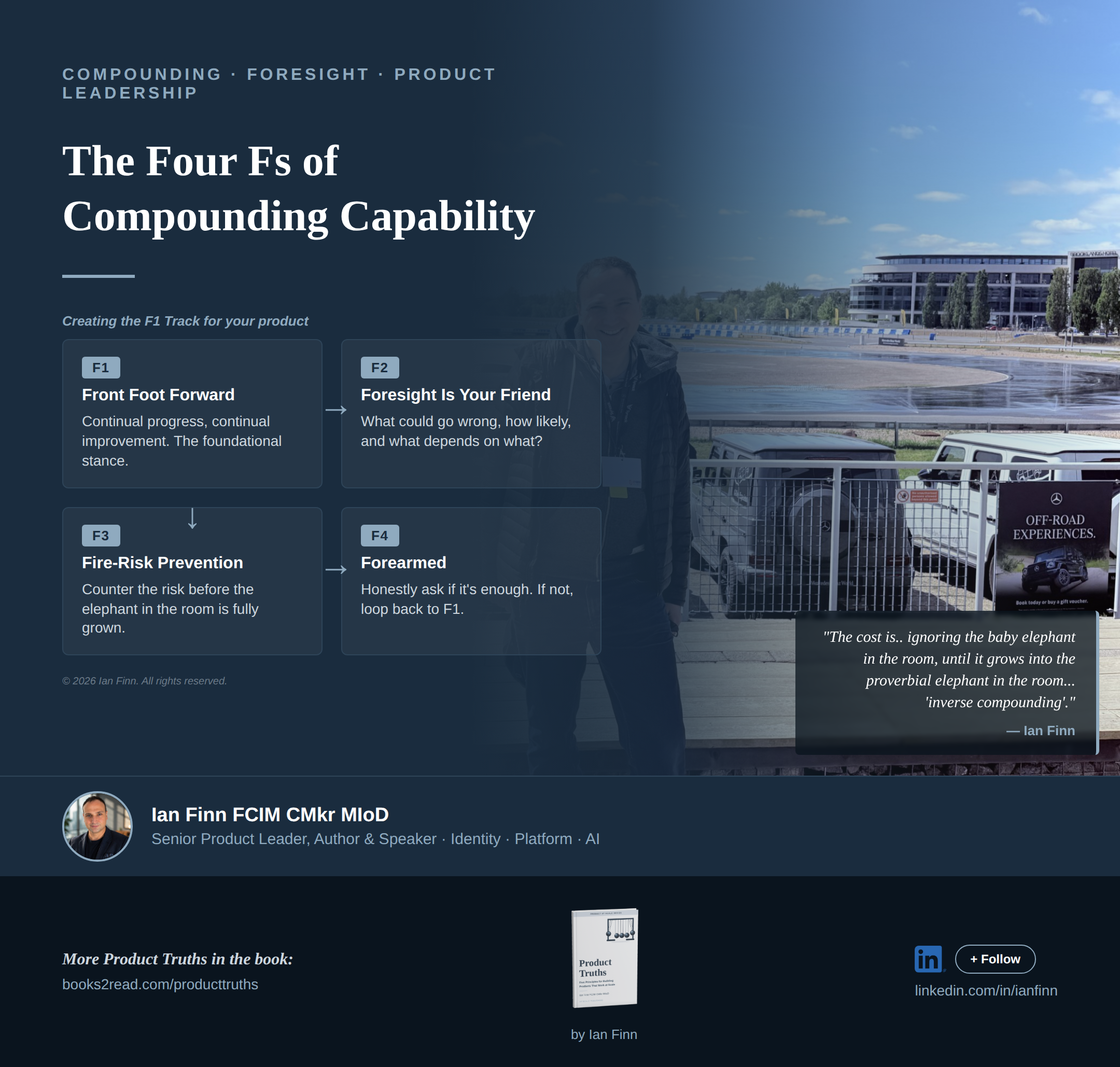
The framework I've developed in this area, applied to products I've led across four different sectors, is one I call the Four Fs.
I built this framework from watching priorities in product default to the 'highest profile thing', the 'noisiest thing', or the 'flavour of the moment'. All of this creates its own noise, and distorts what a product is primarily set up to do. (Bonus tip: leaning into your Product Vision in such moments is never a bad idea either, or even stress-testing it to check it still holds true). The cost is ignoring the baby elephant in the room, until it grows into the proverbial elephant in the room. I call that ‘inverse compounding’.
1. Front Foot Forward
I've always liked Covey's maxim, 'start with the end in mind'. This F is similar, but different. It's the foundational F, and it asks for acceptance of two continuums: continual progress, and continual improvement. That's the very definition of compounding in product, moving forward deliberately rather than reactively, before the next fire forces your hand.
Once a team accepts and aligns with that principle, the art becomes unlocking the compounding benefit. That's where the other three Fs come in.
2. Foresight Is Your Friend
This one's about thinking ahead, before you need to, or before events force you to. It's about being the devil's advocate to your own product's set-up, build and architecture, or getting others to play that role for you, if necessary.
What you're trying to baseline are three things: what could go wrong, how likely is each thing to go wrong, and what other dependencies and wider considerations affect your product performing well under pressure, peak load, unexpected events, macro factors, or attacks and threats from outside.
Use these to baseline what comes next.
3. Fire-Risk Prevention
This is the one I've seen too often overlooked, yet it's often the biggest opportunity in products at scale. The dedication and precision to take what's found in Foresight and counter those risks accordingly, so the ‘elephant’ never fully grows in the first place. Modernisation, patching, refactoring, all components of this F. But so too are more nuanced plays: test and learn rather than fail and burn, and genuinely mapping your true dependencies, have you really mapped every endpoint?
This is the richest opportunity in the Four Fs, and it sets the stage for the final one.
4. Forearmed
We all like to sleep at night, don't we? Product leaders, engineering leaders, teams building and running products, or supporting them in live.
Forearmed is more than the sum of the other three Fs, it's the defining principle. It's taking what they've developed and asking, honestly: does this range of optimisations, enhancements and preventative plays really give our users the most performant, reliable product we can provide? Or does it still fall short? If it falls short, return to the first F and work forward again. Your users, your business, and general karma will thank you for it.
Four Fs, four principles, four ways to build products for tomorrow, not just today. That's the ninth wonder: not compound interest, but compounding capability, deliberately built, ‘F by F’.
>So what's your take? How do you apply foresight and forearmed thinking to your own products? And what's the cost of not acting, if you don't?
> Searching for more ways to compound the benefits in your product? More in the book, ‘Product Truths: Five Principles for Building Products That Work at Scale’. Available at all major digital bookstores (Amazon Kindle, Kobo, Apple Books):
www.Books2read.com/producttruths
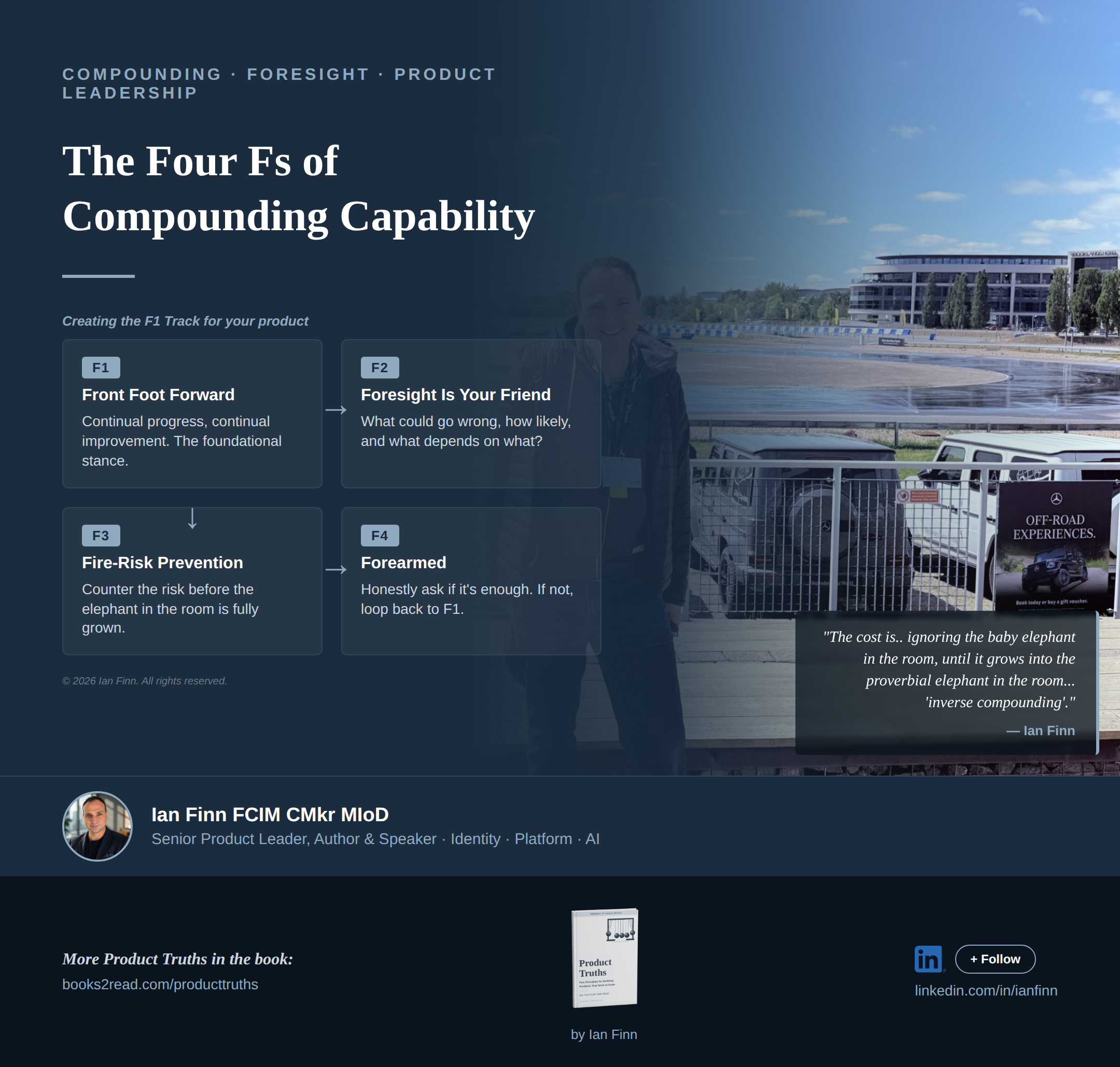
The Four Fs of compounding products. 2026 Ian Finn. All rights reserved