
Does your brand have a critical 'experience gap'?
As we approach the end of 2016, we are now firmly in what Forester have called The Age of the Customer. We are living in a time where highly-informed and digitally-literate (and therefore empowered) customers, and not brands, are now holding the realbalance of power in the brand-customer relationship.
What’s more (as an increasing number of company boards are realising), having a truly-customer centric experience, across a brand’s full range of touchpoints, makes a tangible impact to the bottom line.
So it can be more than a little surprising for a brand’s customer base when they stumble upon a glaring ‘experience gap’ in that brand’s service, proposition or experience (or combination of these).
Yet, as you might expect, such critical experience gaps still do exist - and often where a customer might least expect to find them.
Let’s look at couple of key user cases…
1. “Do you take Contactless?”
In the Age of the Customer (in which customers are increasingly accustomed to product consideration/ transactional/service friction being removed or mitigated by the efforts of brands) when they do hit upon such friction, it can lead to significant detrimental customer sentiment. And sometimes, this detrimental impact can even ripple across an entire service ecosystem.
Take for instance the area of retail payments: a key area of CX in which brands (both retailers and the payments industry) have sought to reduce friction in the transaction – especially via contactless payments. We Brits love the ease of use and fluidity of contactless payments at the point of sale: with contactless now topping over 300 millon transactions per year (over £2 billion pounds worth).
So, what happens when a customer hits a ‘brick wall’ in a shop or restaurant, when looking to simply ‘tap and go’? Remarkably, given that Contactless is now a ‘mainstream’ form of payment (according to the UK Cards Association), the customer desire, the terminal capabilities and the retail offer are still not always aligned.
American Express, for instance, provide Contactless Cards; but in a broad range of outlets, their Contactless Card is often just not accepted for contactless payments at the contactless terminal - even in shops and restaurants who, ironically, accept Amex itself as a form of payment. And, crucially, this service gap often occurs in outlets where rivals such as MasterCard and VISA will work in a contactless fashion.
Limitations with terminal technology/ updates or a lack of retail estate coverage: whatever the issue, the customer simply doesn’t care. They just want to be able to use the service in the way they’ve been led to believe they can. So here, both the payment brand and retailer/ restaurant brand is at the receiving end of consumer disenchantment: yet without knowing where the ‘blame’ really lies. A glaring ‘service gap’ which is plain for all to see.
2. “Do you have this in my size?”
As retailers (and the retail arms of multi-channel brands) continue to focus and grapple on the need to transform to cater for the ‘digital customer’, some other blasts from the past can appear ever-more anachronistic. Especially when experienced by today’s increasingly savvy and less-prepared-to-cut-you-some-slack consumer segments.
Often, where such business/ service model shortcomings can be most telling for customers, is in the area of ordering an item not in store stock ‘there and then’. Yes, we are all familiar with the capabilities offered by many large-scale retailers here (e.g. you can order an out-of-stock item into your local M&S, or to your home). But such a service offering is still not always the case today in all high street fashion retailers/ medium-sized retailer chains.
Even today, asking the question in some high street retail chains: “do you have these boots in a size 10 please?” can be met by vague and/ or inadequate staff responses such as:
”yes, we do…but you’ll need to order it online” or…
”yes, it looks like we have one in our Kingston store… I suggest you call in there”
Seriously?! The customer may well like the item and all that, but - they’re probably notgoing to drive twenty miles out of their way (especially) to purchase it from you. Especially if you, as a brand, don’t appear to care enough to expedite the whole process for them in the first place - by not implementing service propositions such as store-to-store transfers, web-to-retail orders at the POS and the like…the type of service enhancements which effectively say: “thanks for taking the time to visit our store today…we’re sorry the item you want is not available here today…let’s make it as easy as possible for you to get in for you.”
That’s the type of customer experience most ‘Age of the Customer’ visitors to stores expect today…and the impact of this type of CX on the bottom line? Converting on the sale (that would otherwise be lost to a competitor selling similarly-designed boots), obviously. But the brand engagement/ return visit/ advocacy value of that customer enjoying a frictionless experience with you? As one payments platform might say, ‘priceless…
So, what to do then?
Such CX ‘own goals’ tend to not to be isolated incidents in 2016.
And, as we can see in the scenarios above, to have a critical service or experience gap in your overall offering always carries with it a negative multiplier effect: either across multiple stores within a retail chain, across thousands of affected customers; or even influencing the sentiment of the friends of those customers affected (with whom they share their experiences). So how can we improve things – for the customer and, in so doing, also for the brand’s health and bottom line?
In cases such as these - where the customer experience falls well short of what would be a minimum acceptable experience in the minds of most customers - I would suggest a 3-stage approach to service improvement.
I call it the 3 A’s: Audit-Assess-Audit:
Stage 1: Audit
Harnessing the full range of insight sources available (including social listening tools, feedback from front-line staff as well as talking to customers themselves via market research) conduct a service & experience audit of where you are now - versus where the customer expects you to be; as well as where rival brands currently are.
So, for the example of ‘ordering the not in stock in the shop’, the outputs of such an audit might look a little something like this:
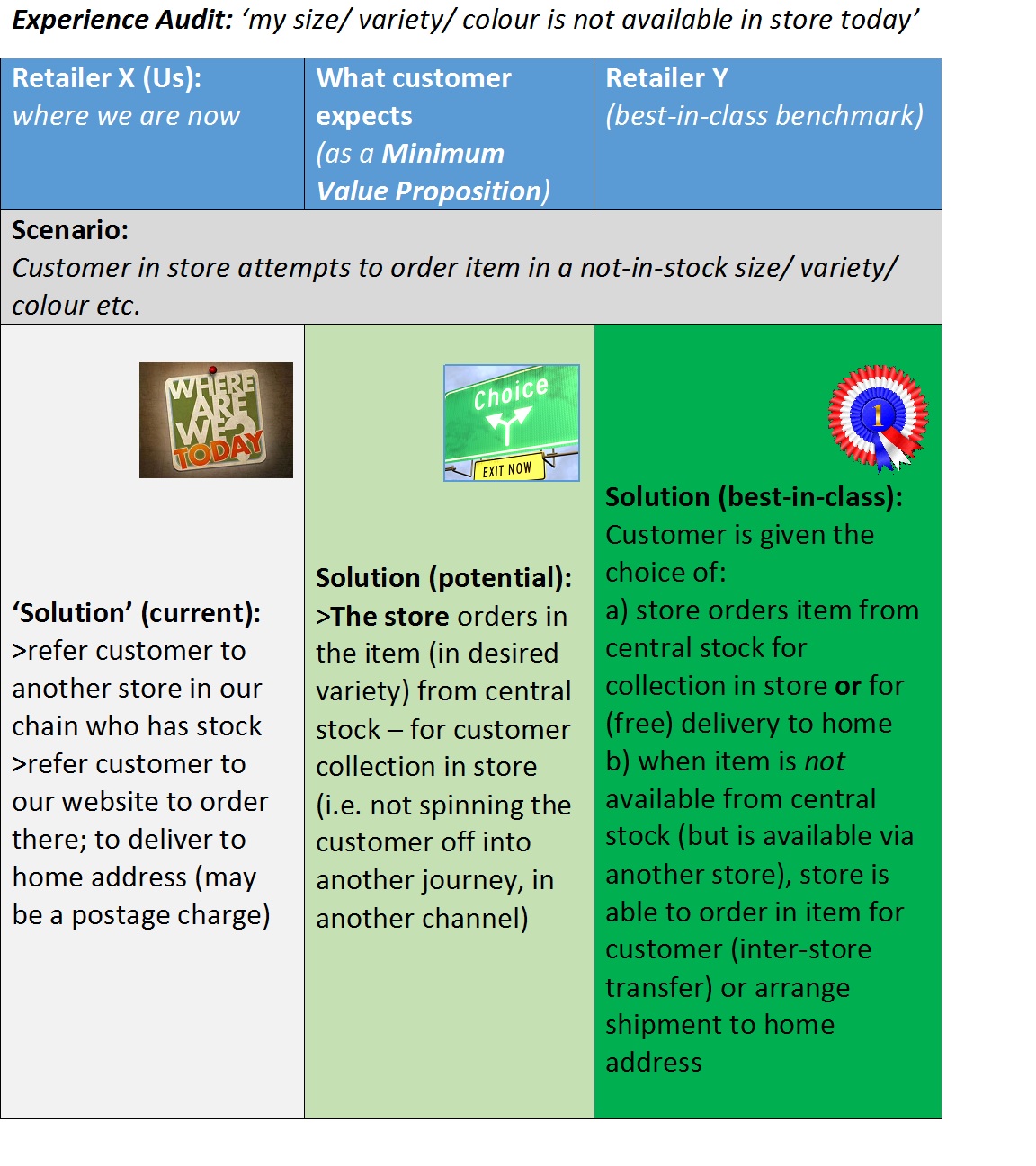
2. Assess the options (decide & implement):
Taking the outputs of this service audit (which highlights the experience gaps between both the ‘as is’ and ‘to be’ states (as well as versus the customer expectation and the competition), you can then assess, and define, the nature of the experience improvement you will look to implement to close the gap. Here you are looking for the strategic option that represents the best fit across your brand/ service promise, making a meaningful experience improvement as well as being implementable, given your available resources.
So, for this scenario, the chosen solution might be along the lines of:
‘we will implement a supply chain process change for phase 1 which will allow customers to order an out-of-stock item (to chosen store or to home with free delivery) from central stock inventory’.
Roadmap in the change and implement.
3. Audit (again):
Measure for the results of the change, to audit the impact via a ‘before-and-after’ lens.
So, for this type of service enhancement, it would be prudent to measure the ‘as is’ state for a fixed period prior to the process change (e.g. how many lost sales opportunities at what £ value in store across the estate/ what level of resulting poor CX) and then measure the same metrics in a corresponding fashion (for an equivalent period of time) once the process change has been made.
The differences of such CX enhancements, more often than not, should be clear-cut: as well as both CX and bottom-line enhancing.
So, does your brand have key ‘experience gaps’?
Do customer scenarios like this ring true with any elements of your brand and its service design for customers? If so, what are you doing to address them?
After all, in the Age of the Customer, it’s the brands who look to remove as many of these critical experience gaps as possible who will best serve today’s ever-more demanding customers. It is these brands, therefore, who will truly succeed.

Ian Finn talks about emerging and future digital trends
Interview on user experience with Ian Finn: UserZoom Conference, London, 2015
Interview on user experience with Ian Finn: UserZoom Conference, London, 2015
'VWGate': unravelling what it means for business ethics

Author: Ian Finn
It’s been the business news item of the week. Actually, it’s been the news item of the week – full stop. The deliberate and willful deceit by the world’s largest car manufacturer in respect to the level of pollutants their cars actually put out. When not under test conditions. The reaction to the VW scandal has generally been one of shock and disbelief across the spectrum: how could such an established and widely-respected brand stoop to this?
But as shock starts to give way to public revulsion to this calculated deceit, the enquiries - both public and private - will now start in earnest. A pivotal part of these corporate post-mortems will be:
-‘so what does this all mean for the way in which big business is conducted in today’s world?’
-‘Just who do corporations actually exist to serve?’
I would argue that this whole automotive debacle just underscores what should already be instilled in big business ethics (but, as we have seen this week, is clearly not universally-enshrined). And that is to say that businesses need to exist within a clear, and guiding set, of principles which consequently set the framework in which all facets of that business are conducted. In the case of VW, one of these should have clearly have included ‘don’t seek to sidestep regulation’. But clearly that particular horse has now long since bolted.
So in the light of ‘VW Gate’ what should such principles look like? Naturally, business principles need to be relevant and tailored for specific industries and the individual organisations operating within them. But I would suggest that are some ‘inalienable truths’ that should inform the set of business ethics for any given organisation; no matter what line of business it’s in. And that should be to…
1…be stakeholder-centric: and work back from that
This is the principle where it should all begin and end really. Since all businesses are, ultimately, set up to serve a set of stakeholders. After all, you can guess the reactions of a VW shareholder who saw 20% of their investment wiped off their balance sheet in just one day when the story broke (only to suffer a further 20% fall the following day). The US Environmental Protection Agency (EPA) is the stakeholder whose standards have been bypassed by VW in such a calculating manner. And of course there is the end customer. You only have to take a passing glance at social media this week to witness the jibing of VW owners about their previously-proud choice of car brand. Customers who have gone from being proud owners of the marque to becoming disillusioned protesters in the space of just one week.
So the principle here should be quite a simple one: one which should always be enshrined in corporate visions and missions, no matter what the industry or point in time. And that is to:
>‘do the right thing for all your stakeholders. Be they your staff, your shareholders, industry bodies or, of course, your customers’.
Naturally the interests of various groups of stakeholders in an organisation will vary - and will often be in conflict with one another. But part of the art of good business is achieving the best balancing act between these interests.
To see the degree by which all three main external groups in the VW stakeholder community have been so simultaneously wronged by this episode is, quite simply, baffling. But what we must take away from witnessing this flagrant disregard for both regulatory and business standards should be this. That serving the full range of stakeholders that a business has should always form the centre of its world. From this principle all others should actually flow…
2. …be compliant
The extent of business impact brought by regulation obviously varies significantly by industry. In the automotive sector, standards can be exacting as the world generally looks to move to being a cleaner, greener planet.
But regulations are not there to be simply flouted: that way madness lies (clearly). It’s a lesson that the banks have learned at close quarters in the aftermath of the 2008 financial crisis. Regulations usually exist for cogent reasons. These reasons are there sometimes to ensure customer interests are met, ensure fair business practices or to protect the planet and the air we breathe (as in this case). Or, indeed, to protect all three interests simultaneously; or even to prevent/ mitigate still further undesirable potential outcomes of doing business.
So regulations should be respected and adhered to by businesses. Not deliberately avoided as here. So the principle here should be as simple as:
>‘as a business, we’ll comply with all relevant regulatory standards’
3. …be realistic to be credible
In the VW case, it appears that it simply wasn’t technically possible for their diesel engines to be manufactured in line with the prevailing US emissions standards. Which begs the question: why, then, position that particular product line in that market if the only way to do so was to facilitate the rigging of emissions testing?
We’re all familiar with ‘SMART’ objective setting in business. As we know, the ‘R’ here stands for ‘realistic’. And it is this ‘R’ for realistic which looks to have been unachievable here - for this particular product line in this particular market.
So then surely businesses should take a step back and reassess what that means: for the products, the business and, of course, their full range of stakeholders. In this case, it might have been that some alternate strategy could have succeeded. This might have been to position cleaner petrol (or indeed even hybrid) product lines primarily in the US market. But that’s not what happened here.
So the principle here, to inform business ethics, I would suggest should be this:
>‘we’ll strive, at all times, to be the best business we possibly can be for our customers and our stakeholders…but also ensure we operate in a way that is realistically attainable for us and our prevailing capabilities’.
Had VW taken a more ‘grounded’ approach to their technological and market strategy here, one can only assume a very different outcome would have transpired (i.e. not a strategy that was dependent on some hidden lines of code, within the engine management system, influencing what the cars’ emission readings would be under test conditions).
Making it ethical
So there we have it. Three suggested ‘guiding principles’ for businesses when setting out (or indeed, re-visiting) what their business ethics should be. In the context of the real-time, demanding and no-where-to-hide business world which we now all inhabit:
Be…
...stakeholder-centric - and work back from that
…compliant...
…realistic to be credible
In this way, organisations can look to simultaneously satisfy the full range of their stakeholders, avoid multi-billion dollar litigation and seek to build product portfolios and brands which can be the best they possibly can be (but based upon their actual capabilities and market opportunities).
So what do you think? Do you feel that the role played by business ethics requires a fresh evaluation, in the light of the VW story? Or do feel certain business principles ‘still hold true’ and it’s down to how they’re actually implemented/ governed within businesses? Or do you have some other perspective here?
>About Ian Finn
Ian Finn is a highly experienced Digital & Proposition Strategist and Fellow of the Chartered Institute of Marketing (CIM) who has led digital improvement at some of the UK’s largest companies. A diverse career across a range of the UK’s leading B2C service brands means Ian brings an ‘end-to-end’ portfolio of Digital capability spanning Product and Customer Proposition; in addition to Digital/ Customer Experience. Find me on LinkedIn or on Twitter (@IanFinnDigital)
Latest and Greatest:
My writing has moved to Product at Scale on Substack