
My writing has moved
My writing has moved to Product at Scale, on Substack:
https://ianfinn.substack.com/?r=24v344&utm_campaign=profile&utm_medium=profile-page
Great evening last night at #ProductTank, London
A great evening of talks last night at #ProductTank, London.
The theme for the night was 'how to develop products when your customer is not your user'. Fascinating perspectives from all three speakers. Interesting thoughts also on the backlog:
'the backlog is your enemy - eliminate it every 90 days, and start anew'.
#ProductManagement #digitaldesign
![20170628_202936[1].jpg](https://images.squarespace-cdn.com/content/v1/5579ae03e4b042afe8ec3608/1498738110393-M1DP7X9I7CKCYA3EOKQJ/20170628_202936%5B1%5D.jpg)
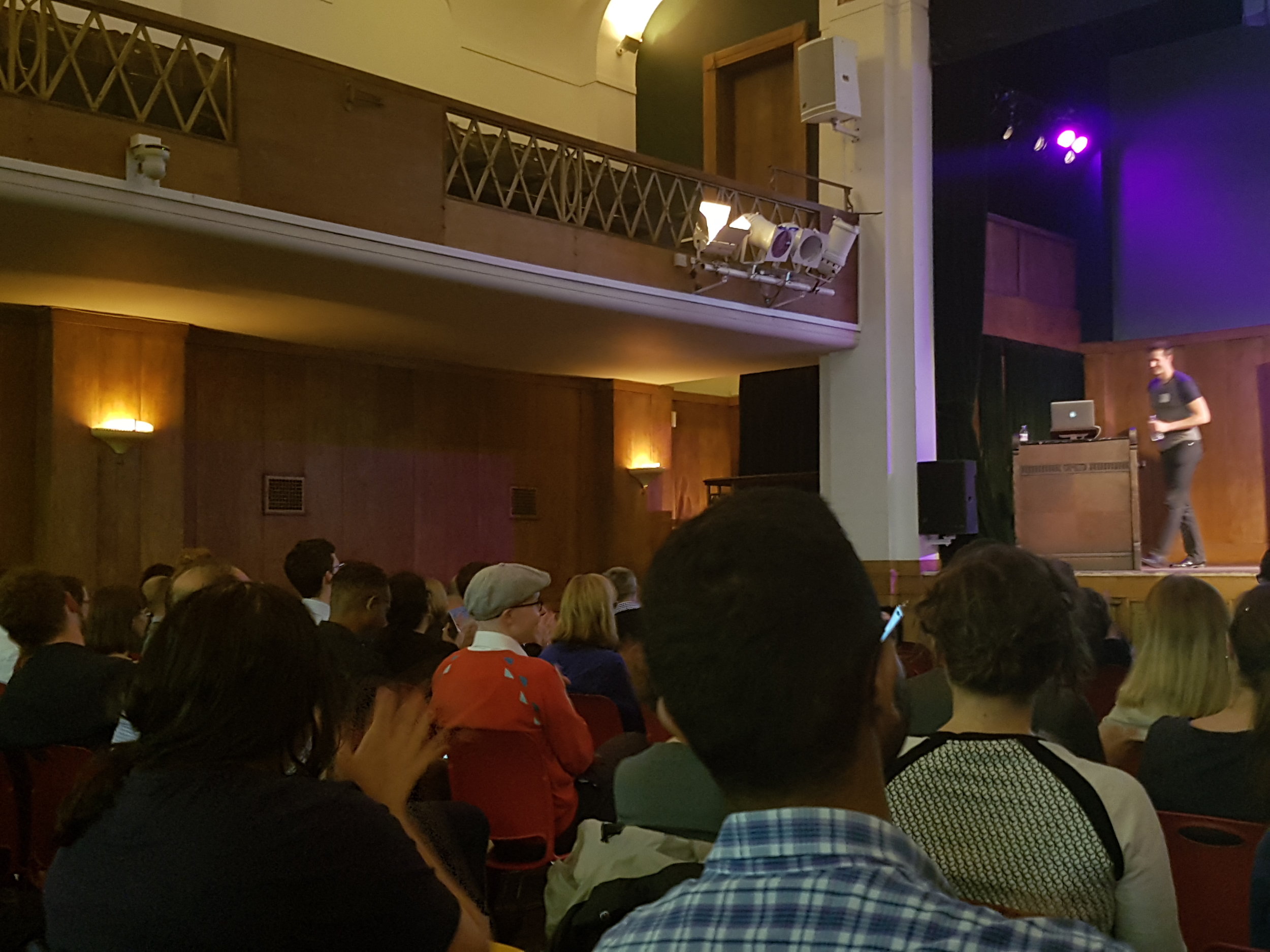
#ProductTank
Successful launch of cutting-edge CRM for government (Department of International Trade)
Delighted to have launched my latest government project this week.
A new, global in-house CRM with cutting-edge capabilities for the Department of International Trade (DIT). Great team effort from Team Data!
Great work guys... we got there. Like we always said we would!


Museum of Failure opens in Sweden
'Museum of Failure' opens in Sweden: paying homage to a liternay of products which didn't quite capture the public's imagination. My favourite has to be the Colgate Lasagna (!). Raises interesting questions about common corporate perspectives on 'failure' versus the 'fail fast' ethos of Agile (treating failure as a learning opportunity, for ongoing optimisation).
It's great to meet fellow Digital Enthusiasts!
A very enjoyable evening last Friday, meeting fellow digital/ service design-focussed people - at Silicon Guildford event. Made all the more enjoyable by one member bringing his rather endearing Husky along for the ride! Thanks to #Cressive for sponsoring the evening. #SiliconDrinkabout, #DigitalHusky



Does your brand have a critical 'experience gap'?
As we approach the end of 2016, we are now firmly in what Forester have called The Age of the Customer. We are living in a time where highly-informed and digitally-literate (and therefore empowered) customers, and not brands, are now holding the realbalance of power in the brand-customer relationship.
What’s more (as an increasing number of company boards are realising), having a truly-customer centric experience, across a brand’s full range of touchpoints, makes a tangible impact to the bottom line.
So it can be more than a little surprising for a brand’s customer base when they stumble upon a glaring ‘experience gap’ in that brand’s service, proposition or experience (or combination of these).
Yet, as you might expect, such critical experience gaps still do exist - and often where a customer might least expect to find them.
Let’s look at couple of key user cases…
1. “Do you take Contactless?”
In the Age of the Customer (in which customers are increasingly accustomed to product consideration/ transactional/service friction being removed or mitigated by the efforts of brands) when they do hit upon such friction, it can lead to significant detrimental customer sentiment. And sometimes, this detrimental impact can even ripple across an entire service ecosystem.
Take for instance the area of retail payments: a key area of CX in which brands (both retailers and the payments industry) have sought to reduce friction in the transaction – especially via contactless payments. We Brits love the ease of use and fluidity of contactless payments at the point of sale: with contactless now topping over 300 millon transactions per year (over £2 billion pounds worth).
So, what happens when a customer hits a ‘brick wall’ in a shop or restaurant, when looking to simply ‘tap and go’? Remarkably, given that Contactless is now a ‘mainstream’ form of payment (according to the UK Cards Association), the customer desire, the terminal capabilities and the retail offer are still not always aligned.
American Express, for instance, provide Contactless Cards; but in a broad range of outlets, their Contactless Card is often just not accepted for contactless payments at the contactless terminal - even in shops and restaurants who, ironically, accept Amex itself as a form of payment. And, crucially, this service gap often occurs in outlets where rivals such as MasterCard and VISA will work in a contactless fashion.
Limitations with terminal technology/ updates or a lack of retail estate coverage: whatever the issue, the customer simply doesn’t care. They just want to be able to use the service in the way they’ve been led to believe they can. So here, both the payment brand and retailer/ restaurant brand is at the receiving end of consumer disenchantment: yet without knowing where the ‘blame’ really lies. A glaring ‘service gap’ which is plain for all to see.
2. “Do you have this in my size?”
As retailers (and the retail arms of multi-channel brands) continue to focus and grapple on the need to transform to cater for the ‘digital customer’, some other blasts from the past can appear ever-more anachronistic. Especially when experienced by today’s increasingly savvy and less-prepared-to-cut-you-some-slack consumer segments.
Often, where such business/ service model shortcomings can be most telling for customers, is in the area of ordering an item not in store stock ‘there and then’. Yes, we are all familiar with the capabilities offered by many large-scale retailers here (e.g. you can order an out-of-stock item into your local M&S, or to your home). But such a service offering is still not always the case today in all high street fashion retailers/ medium-sized retailer chains.
Even today, asking the question in some high street retail chains: “do you have these boots in a size 10 please?” can be met by vague and/ or inadequate staff responses such as:
”yes, we do…but you’ll need to order it online” or…
”yes, it looks like we have one in our Kingston store… I suggest you call in there”
Seriously?! The customer may well like the item and all that, but - they’re probably notgoing to drive twenty miles out of their way (especially) to purchase it from you. Especially if you, as a brand, don’t appear to care enough to expedite the whole process for them in the first place - by not implementing service propositions such as store-to-store transfers, web-to-retail orders at the POS and the like…the type of service enhancements which effectively say: “thanks for taking the time to visit our store today…we’re sorry the item you want is not available here today…let’s make it as easy as possible for you to get in for you.”
That’s the type of customer experience most ‘Age of the Customer’ visitors to stores expect today…and the impact of this type of CX on the bottom line? Converting on the sale (that would otherwise be lost to a competitor selling similarly-designed boots), obviously. But the brand engagement/ return visit/ advocacy value of that customer enjoying a frictionless experience with you? As one payments platform might say, ‘priceless…
So, what to do then?
Such CX ‘own goals’ tend to not to be isolated incidents in 2016.
And, as we can see in the scenarios above, to have a critical service or experience gap in your overall offering always carries with it a negative multiplier effect: either across multiple stores within a retail chain, across thousands of affected customers; or even influencing the sentiment of the friends of those customers affected (with whom they share their experiences). So how can we improve things – for the customer and, in so doing, also for the brand’s health and bottom line?
In cases such as these - where the customer experience falls well short of what would be a minimum acceptable experience in the minds of most customers - I would suggest a 3-stage approach to service improvement.
I call it the 3 A’s: Audit-Assess-Audit:
Stage 1: Audit
Harnessing the full range of insight sources available (including social listening tools, feedback from front-line staff as well as talking to customers themselves via market research) conduct a service & experience audit of where you are now - versus where the customer expects you to be; as well as where rival brands currently are.
So, for the example of ‘ordering the not in stock in the shop’, the outputs of such an audit might look a little something like this:
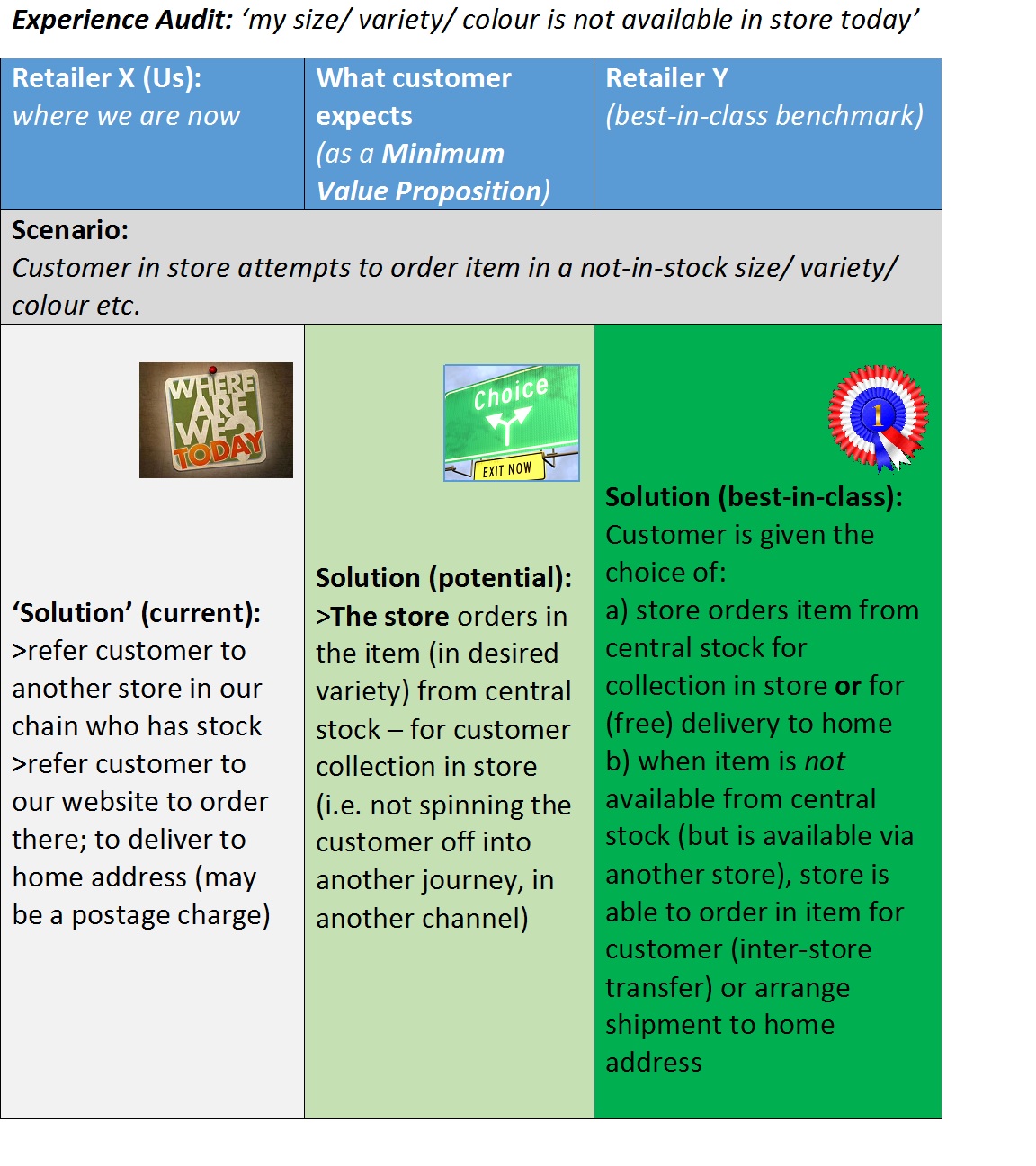
2. Assess the options (decide & implement):
Taking the outputs of this service audit (which highlights the experience gaps between both the ‘as is’ and ‘to be’ states (as well as versus the customer expectation and the competition), you can then assess, and define, the nature of the experience improvement you will look to implement to close the gap. Here you are looking for the strategic option that represents the best fit across your brand/ service promise, making a meaningful experience improvement as well as being implementable, given your available resources.
So, for this scenario, the chosen solution might be along the lines of:
‘we will implement a supply chain process change for phase 1 which will allow customers to order an out-of-stock item (to chosen store or to home with free delivery) from central stock inventory’.
Roadmap in the change and implement.
3. Audit (again):
Measure for the results of the change, to audit the impact via a ‘before-and-after’ lens.
So, for this type of service enhancement, it would be prudent to measure the ‘as is’ state for a fixed period prior to the process change (e.g. how many lost sales opportunities at what £ value in store across the estate/ what level of resulting poor CX) and then measure the same metrics in a corresponding fashion (for an equivalent period of time) once the process change has been made.
The differences of such CX enhancements, more often than not, should be clear-cut: as well as both CX and bottom-line enhancing.
So, does your brand have key ‘experience gaps’?
Do customer scenarios like this ring true with any elements of your brand and its service design for customers? If so, what are you doing to address them?
After all, in the Age of the Customer, it’s the brands who look to remove as many of these critical experience gaps as possible who will best serve today’s ever-more demanding customers. It is these brands, therefore, who will truly succeed.

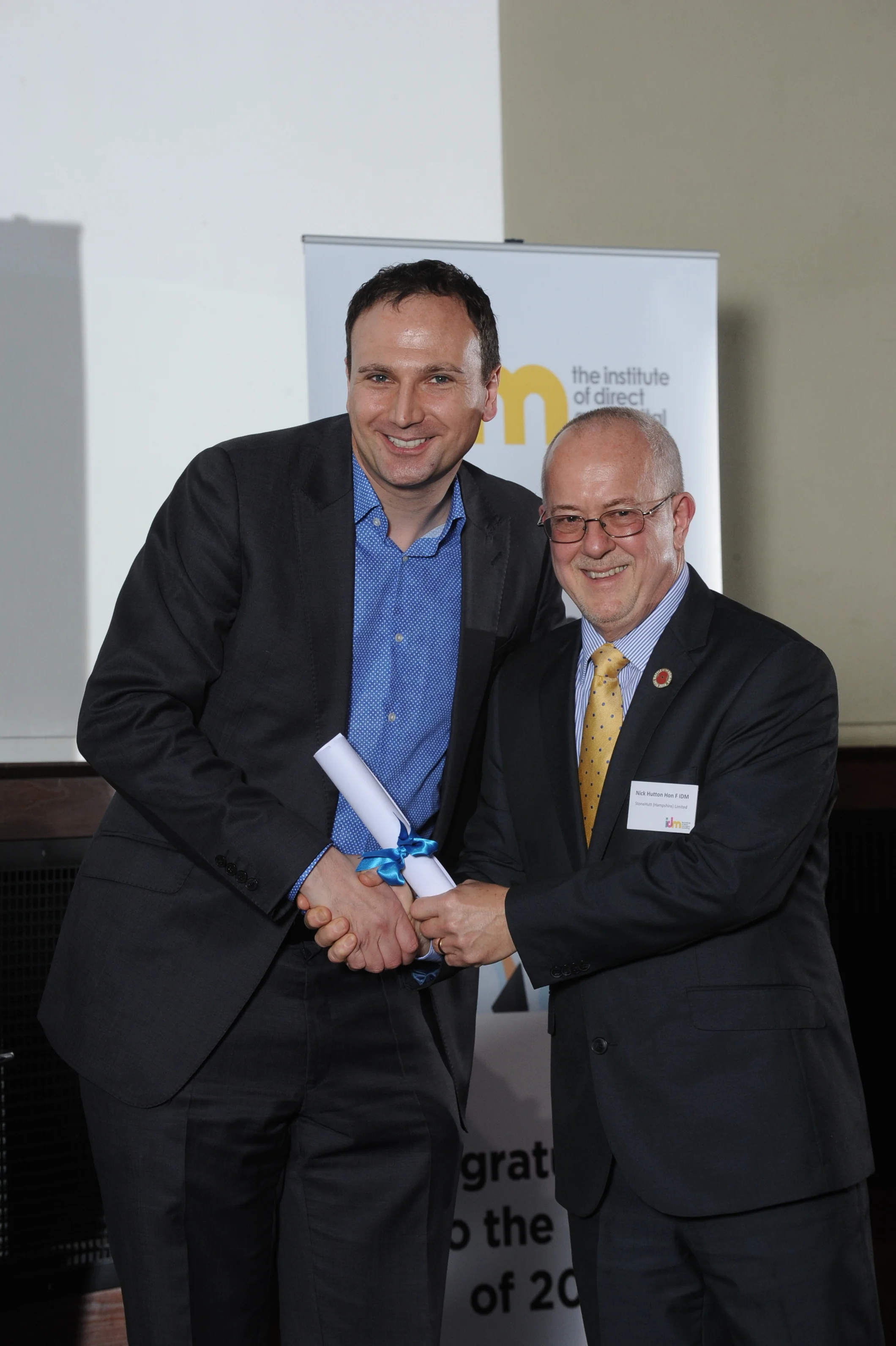
Am honoured to have been amongst them. #idm #idmgrad
https://www.theidm.com/content-resources/press-releases/idm-graduation-ceremony-honours-over-600-marketers

IDM Graduation Ceremony, 2016
Ian awarded IDM Professional Diploma in Digital Marketing (Dip DM)
Feeling honoured: at my graduation today for my post grad digital diploma in digital marketing (Dip DM) @ the Royal Geographical Society #idm #idmgrad

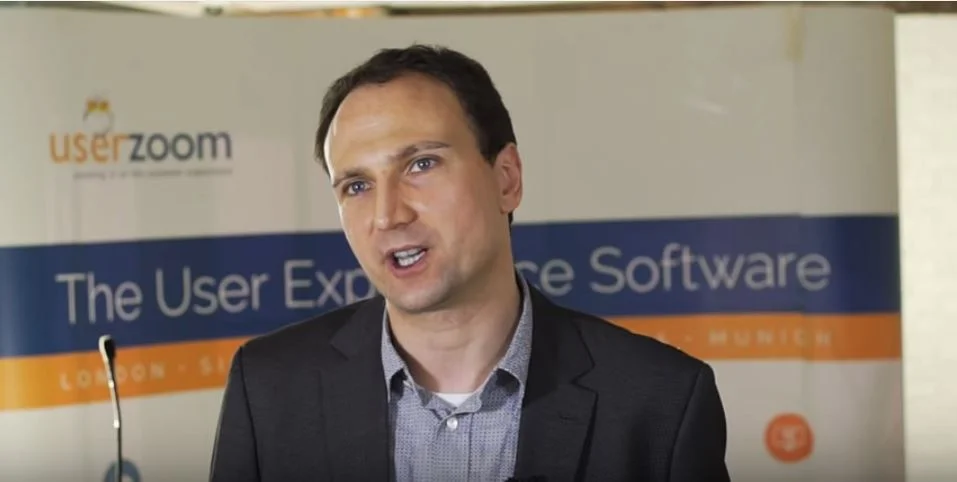
Ian Finn talks about emerging and future digital trends
Interview on user experience with Ian Finn: UserZoom Conference, London, 2015
Interview on user experience with Ian Finn: UserZoom Conference, London, 2015
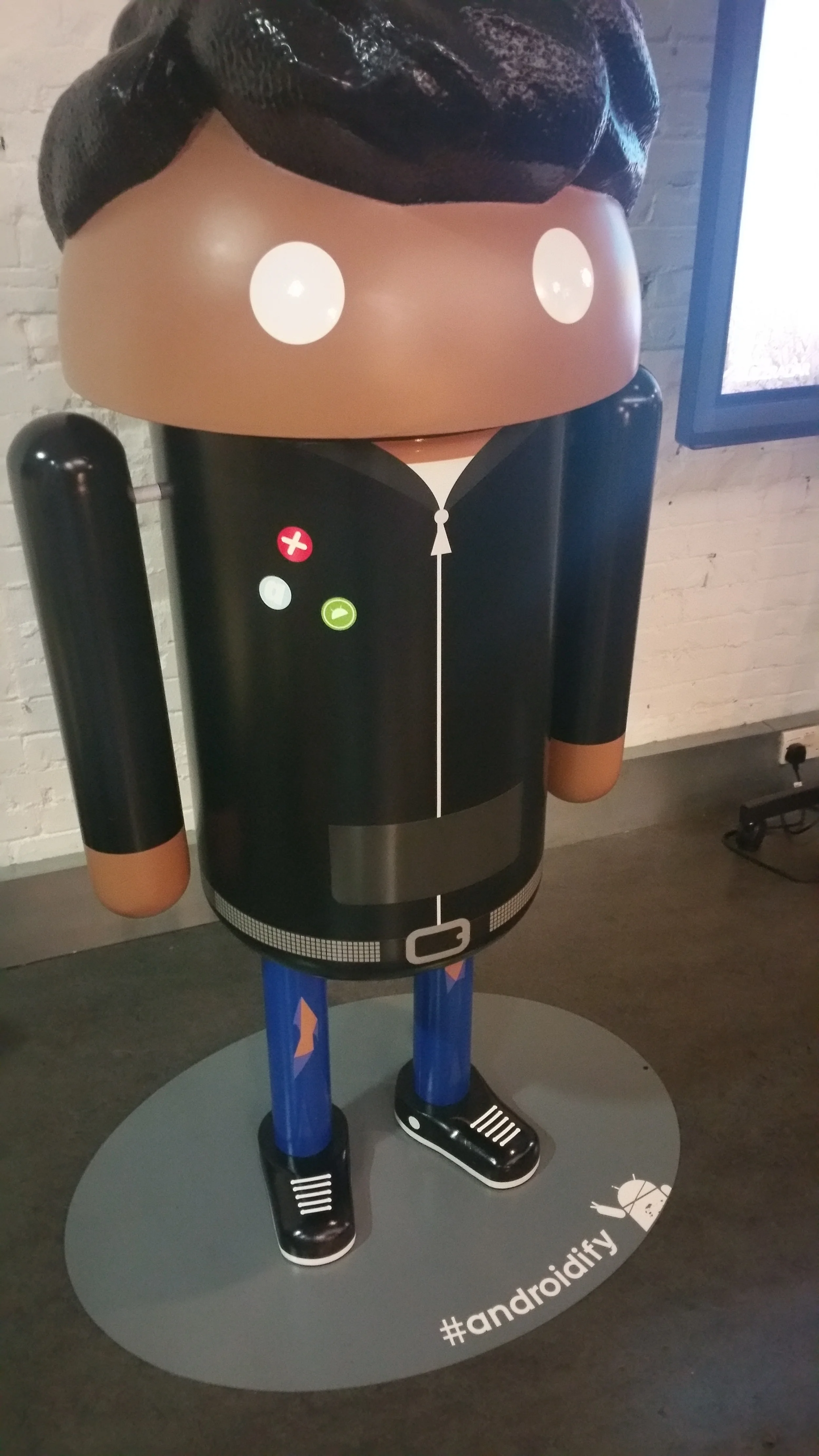
Was at Google Campus, London tonight (11.11.15)
Great evening of insights, ideas and future trends in the AdTech space

An audience with Professor Philip Kotler, 29.09.15
Was privalaged this week to have attended an Audience with the preminant Marketing Mind, Professor Philip Kotler, in London.
Professor Kotler spoke on wide variety of topics spanning marketing, economic theories and the future of capitalism. Simply amazing and thought-provoking to the very final minute.

'VWGate': unravelling what it means for business ethics

Author: Ian Finn
It’s been the business news item of the week. Actually, it’s been the news item of the week – full stop. The deliberate and willful deceit by the world’s largest car manufacturer in respect to the level of pollutants their cars actually put out. When not under test conditions. The reaction to the VW scandal has generally been one of shock and disbelief across the spectrum: how could such an established and widely-respected brand stoop to this?
But as shock starts to give way to public revulsion to this calculated deceit, the enquiries - both public and private - will now start in earnest. A pivotal part of these corporate post-mortems will be:
-‘so what does this all mean for the way in which big business is conducted in today’s world?’
-‘Just who do corporations actually exist to serve?’
I would argue that this whole automotive debacle just underscores what should already be instilled in big business ethics (but, as we have seen this week, is clearly not universally-enshrined). And that is to say that businesses need to exist within a clear, and guiding set, of principles which consequently set the framework in which all facets of that business are conducted. In the case of VW, one of these should have clearly have included ‘don’t seek to sidestep regulation’. But clearly that particular horse has now long since bolted.
So in the light of ‘VW Gate’ what should such principles look like? Naturally, business principles need to be relevant and tailored for specific industries and the individual organisations operating within them. But I would suggest that are some ‘inalienable truths’ that should inform the set of business ethics for any given organisation; no matter what line of business it’s in. And that should be to…
1…be stakeholder-centric: and work back from that
This is the principle where it should all begin and end really. Since all businesses are, ultimately, set up to serve a set of stakeholders. After all, you can guess the reactions of a VW shareholder who saw 20% of their investment wiped off their balance sheet in just one day when the story broke (only to suffer a further 20% fall the following day). The US Environmental Protection Agency (EPA) is the stakeholder whose standards have been bypassed by VW in such a calculating manner. And of course there is the end customer. You only have to take a passing glance at social media this week to witness the jibing of VW owners about their previously-proud choice of car brand. Customers who have gone from being proud owners of the marque to becoming disillusioned protesters in the space of just one week.
So the principle here should be quite a simple one: one which should always be enshrined in corporate visions and missions, no matter what the industry or point in time. And that is to:
>‘do the right thing for all your stakeholders. Be they your staff, your shareholders, industry bodies or, of course, your customers’.
Naturally the interests of various groups of stakeholders in an organisation will vary - and will often be in conflict with one another. But part of the art of good business is achieving the best balancing act between these interests.
To see the degree by which all three main external groups in the VW stakeholder community have been so simultaneously wronged by this episode is, quite simply, baffling. But what we must take away from witnessing this flagrant disregard for both regulatory and business standards should be this. That serving the full range of stakeholders that a business has should always form the centre of its world. From this principle all others should actually flow…
2. …be compliant
The extent of business impact brought by regulation obviously varies significantly by industry. In the automotive sector, standards can be exacting as the world generally looks to move to being a cleaner, greener planet.
But regulations are not there to be simply flouted: that way madness lies (clearly). It’s a lesson that the banks have learned at close quarters in the aftermath of the 2008 financial crisis. Regulations usually exist for cogent reasons. These reasons are there sometimes to ensure customer interests are met, ensure fair business practices or to protect the planet and the air we breathe (as in this case). Or, indeed, to protect all three interests simultaneously; or even to prevent/ mitigate still further undesirable potential outcomes of doing business.
So regulations should be respected and adhered to by businesses. Not deliberately avoided as here. So the principle here should be as simple as:
>‘as a business, we’ll comply with all relevant regulatory standards’
3. …be realistic to be credible
In the VW case, it appears that it simply wasn’t technically possible for their diesel engines to be manufactured in line with the prevailing US emissions standards. Which begs the question: why, then, position that particular product line in that market if the only way to do so was to facilitate the rigging of emissions testing?
We’re all familiar with ‘SMART’ objective setting in business. As we know, the ‘R’ here stands for ‘realistic’. And it is this ‘R’ for realistic which looks to have been unachievable here - for this particular product line in this particular market.
So then surely businesses should take a step back and reassess what that means: for the products, the business and, of course, their full range of stakeholders. In this case, it might have been that some alternate strategy could have succeeded. This might have been to position cleaner petrol (or indeed even hybrid) product lines primarily in the US market. But that’s not what happened here.
So the principle here, to inform business ethics, I would suggest should be this:
>‘we’ll strive, at all times, to be the best business we possibly can be for our customers and our stakeholders…but also ensure we operate in a way that is realistically attainable for us and our prevailing capabilities’.
Had VW taken a more ‘grounded’ approach to their technological and market strategy here, one can only assume a very different outcome would have transpired (i.e. not a strategy that was dependent on some hidden lines of code, within the engine management system, influencing what the cars’ emission readings would be under test conditions).
Making it ethical
So there we have it. Three suggested ‘guiding principles’ for businesses when setting out (or indeed, re-visiting) what their business ethics should be. In the context of the real-time, demanding and no-where-to-hide business world which we now all inhabit:
Be…
...stakeholder-centric - and work back from that
…compliant...
…realistic to be credible
In this way, organisations can look to simultaneously satisfy the full range of their stakeholders, avoid multi-billion dollar litigation and seek to build product portfolios and brands which can be the best they possibly can be (but based upon their actual capabilities and market opportunities).
So what do you think? Do you feel that the role played by business ethics requires a fresh evaluation, in the light of the VW story? Or do feel certain business principles ‘still hold true’ and it’s down to how they’re actually implemented/ governed within businesses? Or do you have some other perspective here?
>About Ian Finn
Ian Finn is a highly experienced Digital & Proposition Strategist and Fellow of the Chartered Institute of Marketing (CIM) who has led digital improvement at some of the UK’s largest companies. A diverse career across a range of the UK’s leading B2C service brands means Ian brings an ‘end-to-end’ portfolio of Digital capability spanning Product and Customer Proposition; in addition to Digital/ Customer Experience. Find me on LinkedIn or on Twitter (@IanFinnDigital)

Getting it right for consumers is not the preserve of Digital
Exploring the parallels between providing a great digital experience to providing a great contact centre experience
In a bid to improve the lot of UK consumers, a new unified Consumer Ombudsman service was launched last month. Reacting to the news, Jo Causon, CEO of the Institute of Customer Service commented, “this is a wake-up call for any organisation that only gives an after-thought to complaint handling and customer service.” Further, the recent UK Customer Satisfaction Index found that just 27% of customers do not now take organisations to task when things go wrong, whilst 41% had to escalate issues they had complained about.
This could make for depressing reading. But it got me thinking. With the surge in brands digitising their businesses and moving to ever-leaner structures as they digitally transform, could we perhaps be forgetting some of the essential tenants of serving the customer well – particularly via ‘traditional channels’? Indeed, some of these challenges of serving customers well via contact centres should be starkly familiar to us. From the parallels that can be drawn in how UK brands have become increasingly digitally-focussed over the last 4-5 years:
1. Making it a mission to just talk to a fellow human being…
it’s a like a web page that takes an age to load/ or an app that crashes as soon as you open it
Have you ever been on the receiving end of this type of telephone-based customer service? You know the drill: ‘…you will now be presented with 7 options: choose option 1 to change your payment details, option 2 to tell us you’re going to pay your bill, Option 3 for…’ Chances are you have been; we all have. These robotic, clinical and automated modes of interaction with brands are almost universally loathed by the consumers forced to use them (even more so when option selection is made via non-voice recognising ‘voice recognition’ technology’). ‘Sorry, I didn’t quite catch that’ often being the tinny reply from the machine you’re ‘talking with’.
I get it: contact centres are often set up in skills-focussed teams, and the automated voice menu is there to channel/ filter the call through to the appropriate department/ team whilst managing overall inbound traffic. But where is it written that we should make the customer do all the work for us in a pivotal moment of need? At the point they elected to call us, a likely trigger could well have been they couldn’t work out how to do what they wanted to do online or via their smartphone. So why put up yet another round of barriers to interacting with them at a likely point of frustration?
I don’t know about you, but once I’m presented with 7 options on an automated menu, I’ve forgotten what option 2 was by the time I’ve heard option 7. So I press ‘2’ anyway and then ask the answering contact centre agent to then undertake the work of correctly routing my call. Kind of defeats the object really.
That’s why First Direct get it right in my book: ‘straight through to a human’, as the platypus on their TV advertising assures us. No 7-option, voice driven menus here. Brand-interaction obstacle removed. Bravo. It’s kind of like that media-rich, attractive-yet-simple web page that loads straight away. It just flows.
2. Having a disjointed/ fragmented view of our customer when they call in…
it’s like being presented with a load of ‘personalised’ options which aren’t for me when I log in online
Ah, the seamless, omnichannel experience. The nirvana: having that conjoined view of the customer when they call in which puts - at the agents’ fingertips - their key and recent points of interaction with the brand (no matter what the channel). That’s what’s needed when customers call in…as we’ve seen, only 27% of customers are now prepared to ‘just put up with things’ when they go wrong.
Unfortunately with many brands today, this is still not yet what is on offer. Legacy system A may not talk to Legacy system B, which in turn has not migrated its data to digitally-transformed system C. Oh dear.
The key here, of course, is to put the customer at the heart of our thinking throughout…and actually design our interaction platforms around them; agnostically of channelised-thinking. After all if, as in many cases where a customer has to call us (e.g. they couldn’t change their direct debit details on our web portal), their interaction with us has already spanned at least two channels. So our thinking here, in response, could be quite inventive (yet simple):
>proactively offer the remedy: if left hanging like this online, don’t hide away the alternative means for the customer to get it done. I was left in just this situation recently when trying to change my direct debit online with a large utility. When it didn’t work, the confusing error message gave me no indication as to why my correctly-entered information wouldn’t work. Yet the contact centre number was nowhere to be seen (concealed, in fact, three layers down on the site, with my having to answer three questions just to obtain it!).
Be customer-centric – it’s not worked online (for whatever reason). That’s where other channels can kick in and pick up the slack: flick on the live chat once dwell time on key service pages has exceeded a certain limit; actually bring the contact centre number into the error message…the remedy opportunities here are literally endless.
>tackle the root causes, continually: monitor and audit ‘points of failure’ in what should be simple tasks which the customer may actually prefer to do online. If they’re not working digitally as expected, then why not? Is it down to user error (and, if so, is that because we’ve made the interaction too confusing?) or is it simply down to us (the back-end computer says no, for whatever reason)? Fixing root causes in this way will then drive online journey completion rates up and call-in rates down. But the monitoring systems have to be in place (and work effectively) to optimise these things on a continual, rather than ad-hoc, basis. Think of this as the ‘business as usual’ end of developing great customer experiences.
3. Cold ‘hand-offs’ of the customer from one agent to another…
it’s like that ‘road to nowhere’ online (broken links, out of date offers/ information)
This is still a very common one; leading brands included. Yes, it can be caused by calls being misrouted (or indeed customers misrouting themselves) but the net effect is the same: each time this happens on a call, customer frustration (as well as total call time for the organisation) builds up cumulatively to intolerable levels.
It’s like clicking on that link in a Frequently Asked Questions section of the website only to find the content there is woefully out of date (or not there at all).
Again, where there is a challenge there is always a solution (or three) just waiting to be implemented. For many brands (First Direct amongst them) multi-skilling of contact centre agents has been a key imperative. With the customer’s first point of contact enabled, empowered and trained to fulfil a wide variety of inbound service requests (and indeed, roles), hand-offs are made mercifully less common in the first place. But on the occasions when a highly specialist customer query requires the input of a more specialised colleague (e.g. a mortgage quote), the handoff is executed in a simple and seamless manner. New agent is pre-briefed by previous agent, no need to go through ID&V (Identification & Verification) once again, and new agent warmed up to the need the customer is looking to resolve. So the conversation can be a meaningful one from the first few seconds.
Sounds so simple doesn’t it? But unfortunately, it’s often the simple solutions which are still not universally-implemented.
In Summary
So interacting with our customers via traditional channels, such as contact centres, is not too dissimilar to interacting with them digitally (in terms of the challenges presented). The solutions to providing a seamless and integrated experience may well look a bit different here to online. But therein lies the opportunity offered to us via the omnichannel model: dove-tailing and integrating previously disparate channels together in pursuit of one aim and one aim alone. How can we set ourselves up to provide the simplest, cleanest and most surprisingly-delightful customer experience imaginable?
After all, 41% of customers having to escalate issues they’d already complained about is a quite a scary statistic. So it’s not just consumers who gain when service channels can be set up to be more integrated, and providing a seamless and harmonised ‘customer flow’ throughout.
So what do you think? What do you make of the current state of B2C service interactions with consumers and how these can be optimised?

4 Key Elements of Great Digital Customer Experience
Exploring what makes a great digital customer experience
Author: Ian Finn
Customer Experience (and particularly the digital variety) is increasingly becoming a ‘hot topic’. And rightly so. As an increasing proportion of brands are switching on to the crucial role that customer experience plays (across the full customer life cycle) there emerges an ever-increasing appetite to ‘do the right thing’ for customers.
And doing the right thing for customers also brings undeniable benefits to business performance and the bottom line – no wonder, then, that Customer Experience is steadily climbing up the priority list of many a CMO and CTO. As noted in Forrester’s report The Business Impact of Customer Experience, there are substantive commercial gains to be found in providing leading-edge customer experiences. Within this report, an analysis of US firms showed a +43% increase in business performance in the period 2007-12 for the firms rated as ‘CX Leaders’. Whereas the business performance for the S&P500 group of companies as a whole showed an uptick of just +14.5% for the same period. Quite a difference.
So customer experience matters: both commercially as well to serve customers in ways that either meet or, ideally, exceed their expectations. And it matters particularly in the digitally-reliant world we are moving inextricably towards. When ‘online’, customers’ attention spans when interacting with brands are often shorter - and their attitude less forgiving than in other channels. Imagine, for instance, that moment when you’re sat on your sofa at home trying to complete the most simple of transactions (such as booking a hotel room via a bookings site). But the site is just taking far too long to bring up your selected choice (whilst it contacts back end servers that the customer neither knows nor cares about).
So if we have even less margin of error to play with in these digitally-connected moments of truth than in ‘traditional/ offline’ touch points, how do we ‘get it right’ for them?
The Four ‘I s’
Clearly much has been written on what makes a great digital customer experience. But I like to distil all this down to a simple, 4-element approach.
I call this approach ‘The Four I’s’. Here goes:
>Element 1: ‘Intuitive’:
It was Steve Krug, in his seminal book focussed on the online experience Don’t Make me Think who talked about the need for digital experiences to be ‘as expected’ for the user; and usable as a result. I would contend that this first element, of being ‘Intuitive’, is probably the most important of all four. Since this is about making your experience work in line with how your customers think. The most we should expect of our customers, in their busy and distracted lives, is just a bit of a goodwill from them towards our online offering - a tiny bit of time investment to ‘get to know’ a new online process or journey. But this needs to be intuitive.
Since if a digital experience is not intuitive, customers often have a tendency to give up and leave your digital experience behind all together…in favour of someone else’s that is easier to use. Take, for example, online investing. This is a product category where invariably (due to the complex nature of the service line) there is often a lot of information on screen for the user to decipher and engage with. So any digital tweak to make the customer’s online experience just that little bit easier makes for big customer experience gains.
I like the customer-centric approach that Hargreaves Landsdown have taken here, in the ‘intuitive’ area. Not only is their Stocks & Shares ISA/ Share Dealing platform clean and uncluttered and well laid out for at-a-glance viewing, but the ease of use starts from the moment you log in. No having to recall, unaided, the ‘second’ and ‘forth’ and ‘sixth’ characters of your account password here. These details are still requested (to offer secure access) but a welcome helping hand is provided to the customer. And it’s brilliantly simple in its execution: just a selection of ‘character masking stars’ taking the place of the ‘non-requested’ password characters, to help you recall your overall password. A little piece of helpfulness; but not everyone does it.
>Element 2: ‘Integrated’:
After ‘Intuitive’, the principal of creating ‘integrated’ customer experiences is right up there for me. Since there are few things more frustrating for customers than their feeling that the ‘left hand doesn’t know what the right hand’ is doing - within the brands providing their services for them.
Take, for example, a scenario such as looking to buy a new car. I’ve often had this experience myself where, having requested a test drive online, one of two irritating things tend to happen. Either: a) having seen a pop up box saying that my chosen dealer will call me ‘in the next few days to arrange a test drive’, the expected call never materialises (=immediate and catastrophic loss of customer trust/ good will in what is an emotionally-fuelled purchase) or: b) when the car dealer has called me, they appear to lack all my personal details which I’ve already laboriously entered online - demonstrated by looking to reconfirm each and every field again verbally (= intense frustration for customer; brought about by ‘siloed’ customer platforms/ channels).
The way forward in this element is clearly about joining the disparate parts of the end-to-end customer experience together. Whether such disparate ‘bits’ of the overall experience result from different channels not ‘handing off’ properly; or having different back end systems across them… the goal should be to join these experience ‘bits’ seamlessly together. In order to create a cohesive ‘single customer experience’. Often, this requires more investment and thinking by brands at the outset; but the customer and commercial benefits more often than not offer a highly attractive ROI for doing so (see the key improvement metrics referenced in the Forrester report, up the page).
>Element 3: ‘Interactive’:
This is an interesting one, and talks to the concept of having ‘two-way’ communications with our customers online…and at the appropriate points in the customer journey. It is also one which is often inter-linked with ‘Intuitive’ (since by being ‘interactive’ with customers we can often compensate in areas where things haven’t been as intuitive as they might be, for certain individual customers) and also with ‘Innovation’ (more of that later). So how can we interact effectively with customers during their digital interactions with our brands? For me, ‘interacting’ well with customers takes three main forms to help construct a better customer experience:
- ‘Help me’: whether initiated by the customer (such as clicking on a ‘chat now’ button, if experiencing some difficulty in the online journey) or smartly-triggered by the brand (such as an offer to chat appearing on screen when the customer has remained on the same page/field for a while), this is a pivotal moment of truth for both Customer and Brand. The key here is setting up our online journeys to intelligently recognise the most likely moments of customer difficulty; yet without being obtrusive or patronising. A key area of exploration for user experience testing, for sure.
- ‘Help me choose’: depending on the product or service (and its relative complexity) not all customers may have a ‘ready-made’ selection locked in their minds; or feel well-informed enough to make one. This is where ‘facilitative’ solutions within the end-to-end customer journey (such as Amazon’s ‘More items to consider’ feature) can provide that little bit of inspiration - when needed.
- ‘Make it mine’: this is about personalising experiences for our customers. But it’s about going beyond just requesting customers to opt into cookies, to then help us remember them a little better next time, on a superficial level. This is a key moment of truth to thrill customers with unexpected delights: such as providing an ever more personalised web page experience when the customer returns to our site. An experience based on all the insight organically built up about that customer through their various interactions with us: whatever channel those interactions took place in.
- ‘Help me’: whether initiated by the customer (such as clicking on a ‘chat now’ button, if experiencing some difficulty in the online journey) or smartly-triggered by the brand (such as an offer to chat appearing on screen when the customer has remained on the same page/field for a while), this is a pivotal moment of truth for both Customer and Brand. The key here is setting up our online journeys to intelligently recognise the most likely moments of customer difficulty; yet without being obtrusive or patronising. A key area of exploration for user experience testing, for sure.
>Element 4: ‘Innovation’:
I’ve placed this element last for a reason. Not because it isn’t a key consideration for us - far from it. But depending on the needs of our customer base it may, or may not, be a relevant part of our customer experience mix. Innovation for innovation’s sake often risks serving the needs of our brand; rather than those of our customers. And could, therefore, potentially risk the simplicity and purity of easy-to-use and effective experiences - discussed under ‘Intuitive’.
Rather, the really meaningful role for innovation should be to address identified unmet (or partially-met) customer needs; when just ‘more of the same’ won’t solve the customer’s pain or problem. And something much more fresh and game-changing is needed instead.
For this element, I would highlight again some of the pioneering thinking over at Amazon: actually, an innovation that is still being innovated. If, for Amazon, the identified customer issue is a growing need/ desire to receive their purchases increasingly quicker (‘Same Day’; not ‘Next Day’) then contemplating innovations like direct-to-customer delivery - such as via air-bourn Drones - starts to make a kind of sense. If pre-existing delivery platforms (such those offered by third party delivery firms or even via their own ground-based delivery operation at some point) can’t fulfil a need for ‘same day delivery’, then full-scale innovation might be the ally to a new, great customer experience.
Wrapping it up:
So there you have it -my take on four critical elements for creating a great overall customer online experience. The type of experience that these days customers not only crave, but actually expect.
So what do you think? What are your views on what makes a digital customer experience ‘great’?
Do please share your views and perspectives below. And if you’ve liked what you have read, click on ‘Follow’ to hear more going forward.
>About Ian Finn
Ian Finn is a highly experienced Digital & Proposition Strategist and Fellow of the Chartered Institute of Marketing (CIM) who has led digital improvement at some of the UK’s largest companies. A diverse career across a range of the UK’s leading B2C service brands means Ian brings an ‘end-to-end’ portfolio of marketing capability spanning Product and Customer Proposition; in addition to Digital/ Customer Experience.
Connect with me on LinkedIn or find me on Twitter (@IanFinnDigital).

Sometimes it's the 'Little Things' that make a great Digital Difference
It's not always the large-scale digital transformations that pave the way to better digital customer experience
Author: Ian Finn
Digital Transformation, particularly transforming into the omnichannel and ‘seamless’ customer experience, is a pivotal focus for numerous consumer-facing and service brands right now. From Retail Banks looking to take a ‘digital-first’ approach to their sales and service operations; right through to established high street retail brands looking well beyond the high street to where the retail customer journey truly begins (into the home, and to customers’ various browsing devices of choice).
As the digital revolution continues to take hold, and the digital infrastructure to support these new and ever-more interlinked customer experiences is built out, not unsurprisingly significant funds are being invested to arrive at this new ‘omnichannel nirvana’. And necessarily so.
Moving the dial
But meaningfully evolving the digital experiences that brands provide to consumers - as well as developing increased opportunities across the value chain, including for ‘partner’ organisations- doesn’t necessarily always have to cost the big bucks. Sometimes it’s the little tweaks in the user experience/ UI (the key ‘enhancements’) that can play a big part in moving the dial for CX. And bring the commercial benefits along with them too - as a result of more intuitive experiences leading to more user engagement.
Google ‘get it’
A case in point for the benefits of the ‘digital enhancement’ approach right now has to be Google. For Google, it’s not just about the multi-million dollar acquisitions of payment/ mobile wallet, home automation and AI start-ups that so often grab all the headlines (read Customer Value Proposition transformation as well as Digital Transformation here). In addition to creating new and expanded digital eco-systems via such expansion, there is also the optimisation of the ‘core product suite’ which can also move digital experience forward. The ‘core product’ here being the experience that is in our pockets on our Android phones and on our other connected devices - after all, this is actually the beating heart of Google’s day-to-day (and minute-to-minute) engagement with most users.
A little can go a long way
So, discussed here are three ways in which Google have made some oh-so-subtle digital product tweaks of late: product enhancements which nevertheless go towards helping make all the difference to the overall user experience. These aren’t necessarily digital changes which cost the mega-bucks (in the overall scheme of things) but which can help move the dial where it matters most – in the hands of the user, by making life simpler, more intuitive and more joined-up:
>1. Anticipating the user: ‘joining the dots’ and providing user choice
Google recently enhanced its Android version of Google Maps to include a new value-added feature within its navigation options. Punch in a destination which is a store or restaurant etc and the app will now warn you if ‘your destination may be closed by the time you arrive’.
I view this development as somewhat an ‘inevitable innovation’ – given the amount of data aggregation and layering by the world’s pre-eminent search platform. But that is not to say that this enhancement doesn’t advance the digital experience significantly for its users. None of us enjoys a wasted trip; and with this tweak, the experience (of mapping/ navigation combined with ‘service availability’ at your destination) are now seamlessly unified.
The user now has the choice to heed the on-screen warning (call off the planned trip) or else navigate to an alternate destination that may still be open (competitive forces at work, as Michael Porter might term them). Yet another example of how increasingly more choice is presenting itself to us via ever-smarter digital technology; right there on our mobile device.
>2. ‘Don’t make think’*… provide the ‘Next-best action’
Whilst we’re talking mobile mapping and navigation, another more subtle tweak has also been made recently to Google’s maps that you’d be forgiven to have missed. And it’s as simple as that age-old improvement of moving away from 3 clicks when just one will do nicely, thank you very much.
If, like me, upon opening Maps on your phone when ‘Location’ was switched off (to conserve much-needed battery power, naturally) Google Maps’ UI used to just provide you a pop up reminder to ‘enable location’ in your Android settings. Not that helpful or intuitive when you are, more often than not, trying to navigate a busy city street whilst simultaneously maintaining a passing awareness of would-be phone-snatchers.
So a helpful tweak Google introduced recently was for this pop up message to actually offer to switch on your location settings for you, automagically. A smaller scale UI enhancement, for sure: but one which is actually a very contextually-relevant improvement to the experience when a user is commonly using the mapping app (i.e. harassed, in a rush, in a busy street).
>3. “By the way, where’s my data: and what will you do with it?”
Finally, no discussion of the digital user experience and its evolution would be complete without a consideration of privacy and security. Increasingly hot topics, without a doubt. With the growing amount of data (and layered data sets) that are collected as a result of customers using such connected services, Google is increasingly cognizant of users’ growing interest in ‘their <own> data’.
So much so in fact, that Google recently streamlined, consolidated and simplified its privacy and security settings for all Google services: by bringing them all together into one place for the first time. The new ‘My Account’ portal (https://myaccount.google.com/) now allows Google users to much more clearly navigate and adjust their choices in respect to options such as what information is made public via your Google+ profile; right through to the option of opting out of ‘interest-based ads’ (opting out means you will still be served with Ads, just not so personalised).
Again, more evolution than revolution here in terms of the digital self-service aspect. Many of these options were available prior to the introduction of Google’s ‘My Account’ dashboard: but they were spread, rather inconveniently, across various pages and settings across the wider Google platform.
But in an age in which users are becoming increasingly concerned about what data is held on them and how it is utilised, the introduction of the ‘My Account’ feature at least starts to provide a more seamless and intuitive way for people to engage with their data set – and what it means for them.
It also brings the much-needed user benefit that people increasingly crave in their ever-more connected ‘digital lives’: that of increased simplicity and ease of use.
Digital Change: large and ‘small’
Large-scale digital transformation across most consumer-facing sectors is undoubtedly much-needed and benefit-bringing (to both users/ consumers as well as the brands who seek to serve them). Whether this is about replacing age-old, legacy infrastructure in retail banks that would otherwise impede new front-end innovations or developing the intuitive and enticing app front ends that Media brands require, as streaming content becomes the new normal.
But against this backdrop of much-needed large scale ‘infrastructure-level’ digital change let’s not overlook the contribution that can be made by those more ‘business as usual’ enhancements and insightful refinements to the end-to-end digital experience. Since often in Digital Product & Experience it’s the ‘little things’ that can actually make a big difference.
And the 'So what'?
Customer-focused consumer brands need to whole heartily embrace both types of digital change (both large-scale/ infrastructure level and smaller-scale/ enhancement level) in order to really cut through with today’s demanding consumers. Since ever-increasing amounts of digital innovation tends to have an effect on the consumers of digital services to expect things to ‘just work’ more and more. So getting the digital product management right, as well as the digital product development/ transformation is just the ticket…
*’Don’t make me think’: the title of Steve Krug’s seminal work on creating the intuitive digital experience
>About Ian Finn
Ian Finn is a highly experienced Digital & Proposition Strategist and Fellow of the Chartered Institute of Marketing (CIM) who has led digital improvement at some of the UK’s largest companies. A diverse career across a range of the UK’s leading B2C service brands means Ian brings an ‘end-to-end’ portfolio of Digital capability spanning Product and Customer Proposition; in addition to Digital/ Customer Experience.
Find me on LinkedIn or on Twitter (@IanFinnDigital)
Latest and Greatest:
My writing has moved to Product at Scale on Substack